
What to Expect From Your Lawyer: The First Conversation and the Investigation Behind It
A person who calls a medical malpractice lawyer for the first time is usually in the worst stretch of their life. Their lives have been turned upside down, and they are asking me to help with a big problem. They tend to arrive with strong feelings and very little idea of how the law works. What they need from that first conversation is not a speech. They need someone to guide them with a calm hand.
This chapter walks through that conversation from my side of the desk. It covers how I describe my job, why I spend the first call listening, and why a caller reaches me directly. It then follows the work that happens after the call: the interview, the records and the review by practicing doctors. That work takes months before I can tell anyone whether there is a case. It also covers what I say when the answer is no, and where I can and cannot help.
Everything here describes how I work, and each case is different. The medical records get a chapter of their own, and you will find them in Chapter 8.
going into a lawsuit is just like going into a foreign country, and you don't speak the legal terms, and you're not sure how the process works
The lawyer as a client's guide and the roadmap people ask for
The core mission of my practice is to help people in a time of crisis and to treat them with dignity. Part of that is making sure the process I am about to take you through is explained. Many people may not have been through a process like this. Think of anyone who has gone on a trip and hired "a tour guide because we don't know the language and we don't know where to go." A lawsuit is a trip of that kind, with its own terms and its own map, and the person setting out is often doing it for the first time.
Being the guide has a specific meaning. I explain what the process looks like, how long it is going to take, what the potential outcomes are, what the decision points will be for you and what your own involvement is. A lot of people find comfort in that, because "people just want a roadmap." They want to know how this is going to go. The responsibility of a lawyer like me is to provide a calm hand to someone facing something traumatic and uncertain, someone who does not know how the law works.
A guide is not a decision-maker. I would not call myself a problem solver, because that word takes away the client's ability to decide things on their own case. I value my client's input because it is their case, not mine. Whether to file a lawsuit is the client's choice. If I believe a case can move forward, I say so, and then the decision belongs to the client. Many strategy decisions, such as how to word a brief, are lawyer decisions, and I bounce ideas off the client along the way. The client also decides whether to settle, and Chapter 18 returns to that.
Listening first: letting a caller tell the story in their own words
The first conversation is mostly listening, and I spend a lot of time on it. I let people tell me everything they want to get off their chest. A lot of the time they want to vent. As I put it, "I don't talk over people, I let them tell their story."
There is usually a reason they need to. They have been hurt by the medical system, and in many cases they have been ignored by it. A patient may have been having a good relationship with a doctor, then something bad happens and the doctor is never seen again. That person is mad and confused. Giving them the space to say so is part of the job, and I count it as a core part of my mission.
Listening is also the groundwork of the case. The practice of law comes down to understanding how to interact with people, and listening is something I pride myself on. It is not a matter of being the smartest lawyer in the world. The work starts with that first interview: hearing the client's story without interrupting and letting them tell it in their own words from beginning to end. People tell you a lot that way, and it is information you are probably going to need.
Medicine has the same principle. In the part of a visit called the history, the doctor talks to the patient. In my view, that is one of the lost things in medicine, because doctors do not want to spend much time on it anymore. Older doctors will tell you that the more you listen to the patient, the more the patient will tell you about what is wrong. I use that same principle in the interview stage.
Speaking to the lawyer directly, without layers of intake
When you call me as a new client, you reach me. Many callers are surprised. Some say they never thought they would speak to a lawyer, and some ask whether I am a real lawyer or one of the AI voice assistants. I tell them I am a real lawyer. "You get to speak to the lawyer that you wanted to speak to," and I want you to know you are important. I also want to explain the system to you with thirty-five years of experience behind the explanation.
Here is the alternative. A caller may reach an intake person first, and the call then works its way up to the lawyer's desk. That can take weeks or months, and the caller is told only then that there is no case. "I shortcut that process."
Let's suppose the caller has only a lunch break in which to phone a lawyer. Their lives have been turned upside down by medical malpractice, and they still have family, work and other responsibilities. They want to know whether they have something or not. On that first call I can often tell a caller when there is no case. Confirming that there is one takes longer, and the next section explains why. Answering a caller quickly is a point of pride for me, and I think people deserve it.
One caution, as of when I recorded this. After hours I use an AI virtual assistant, because many reception services no longer have live staff around the clock and I want to be sure you are talking to someone. It has been well trained, and it is not a person.
What happens between the first call and a lawsuit
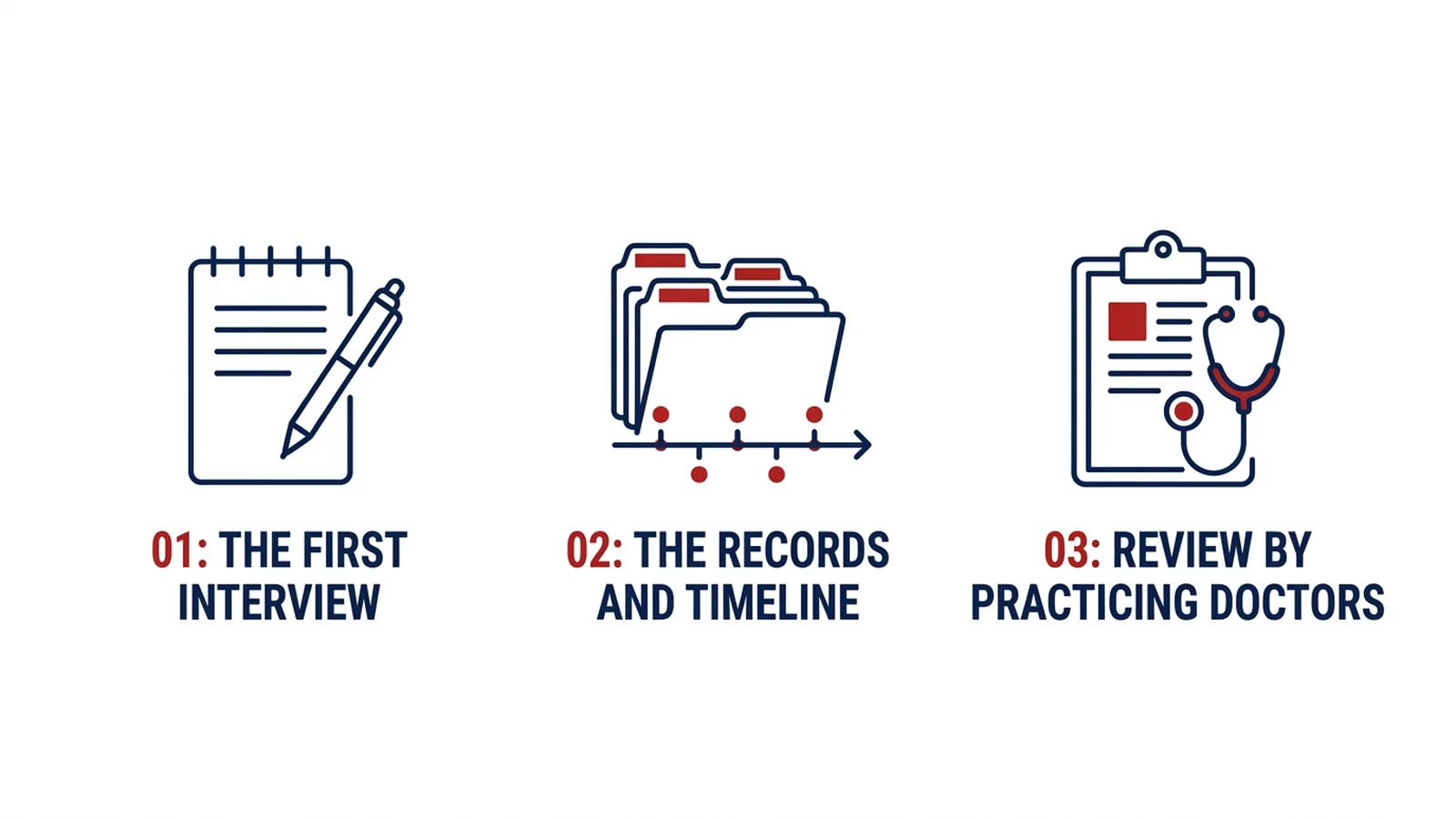
After the call comes the work that decides whether there is a lawsuit at all. In a birth injury matter it runs in three steps.
Step one is the interview. In my experience a lot of lawyers no longer spend enough time on it, and I spend a great deal. I talk with you personally and ask many questions, and you ask me many questions. The conversation runs in both directions until all the information is down. For a birth injury I ask about the labor, about the prenatal care, about what happened afterwards and about what your child is like. At the beginning I also make sure the client's expectations and mine are lined up, and I keep the client informed regularly about how the case is going.
Step two is the records. A lawyer has to go through the medical records with a fine tooth comb and build timelines of when things happened. In my words, by going through the records we can tell whether a delay in delivery caused brain damage or cerebral palsy. How an expert reconstructs a delivery from those pages is the subject of Chapter 8.
Step three is the review by doctors. We consult with practicing obstetricians, or with other specialists who are able to work with us. They go through the records together with us to determine whether the standards of care were met, whether any violation of them caused injury, and how severe and permanent the injuries are. The standard of care is what we call the nationally recognized guidelines for what doctors should and should not do. Chapter 2 explains it in detail.
"So it takes a lot of work on the front end." It takes months of investigation before I am able to tell someone whether they have a case. Confirming a case takes the interview, the records and the doctors' review.
When the answer is no, and the reason that still matters
I represent clients from all walks of life. People used to find lawyers through referrals, and I think that has changed. A great deal of information is out there and a lot of people do research, so callers come from everywhere. I am grateful for it, because I get to help so many different people.
I cannot help most of them. A very small share of the people who call me become cases, so most callers hear a no from me. Either I tell the caller that there is no malpractice here because I do not think the doctors did anything wrong, or there is not enough injury to support a case. Someone who was hurt and got well has little to bring, because of how expensive a case is. Chapter 6 takes up why so many calls end this way.
What keeps me going is the satisfaction of a thank-you, even at the end of a case. I hear it from people I cannot help, too. I tell them why, and the answer I treasure most is a caller telling me they are disappointed there is no case, and then thanking me for being the one lawyer who took the time to listen and explain. A lot of callers have phoned one lawyer after another without learning why none of them would take the case. When I finally explain it, there is a sense of relief. They can close the door on that chapter and go on with their lives, even if they cannot bring a lawsuit.
I have the training and the information, and if I can give that to someone and give them some clarity, I find that satisfying. Sometimes people are disappointed to hear it, and I understand why. There is satisfaction in that for both sets of clients, the ones whose cases go forward and the ones whose cases do not.
Cases across Maryland and the District, and referrals for problems outside my work
A lot of people ask whether a Baltimore lawyer can help them if they live somewhere else. That is a common question when clients call. Most people with a legal issue are more used to speaking with someone in their own area. They do not think a lawyer like myself who is Baltimore based can help them if they live, let's say, in Montgomery County or DC. What I tell them is "I have a license to practice all over Maryland and in DC."
My practice is based in Baltimore City, Baltimore County, Harford County and Howard County, and the surrounding counties. I also have a lot of experience in Montgomery County and Prince George's County, which are suburbs of Washington, DC, and in the District itself. Where I happen to sit does not decide whether I can help. People in other parts of the state or in DC should not doubt that I can.
People also call me about problems outside medical malpractice. Maybe they were hurt at work, or they want to file for disability, or they have an employment issue. When I can, and when I have the right person, I send them there. I tell them it is not what I do, and here is somebody who can help. I went to law school with a lot of people who now practice in Baltimore in divorce, employment and hurt-on-the-job matters. I can offer those resources because "many people don't know who to call." They trust my suggestion because they have called me, and I think of it as having almost vetted those lawyers myself. Talking to everybody, even if I cannot help them, is part of the service I give back to the legal community.
Common Questions
- What happens during the first call with a medical malpractice lawyer?
- Mostly the lawyer listens. I let you tell the story in your own words from beginning to end, and I ask a lot of questions in return. In a birth injury matter I ask about the labor, the prenatal care, what happened afterwards and what your child is like. As I describe it, "It's a two-way street." I do that interview personally, before any of the records work begins.
- How long does it take to find out whether I have a medical malpractice case?
- A confirmed case takes months, though I can often tell a caller early that there is no case. The months go to the interview, a careful read of the medical records and review by practicing doctors. Each case is different, so the time varies.
- Will I speak to the lawyer or to an intake person?
- With me, you speak to the lawyer. "When you call as a new client, you speak to me directly." Many callers are surprised, and I do it to shortcut the weeks or months it can take when a call travels up through intake. After hours, as of when I recorded this, an AI virtual assistant answers so that you are talking to someone.
- Can a Baltimore malpractice lawyer take a case outside Baltimore?
- Yes, in my practice. I am licensed throughout Maryland and in the District of Columbia, and I take cases in both. My concentration is in Baltimore and the surrounding counties, with a lot of experience in the Washington suburbs. Where you live is not the test, because "it's not just geographically driven."
- What if the lawyer cannot take my case?
- Then I explain why, so the caller has a clear reason and can close that door. If the problem is outside medical malpractice, I refer people to lawyers I trust when I can. I tell them plainly that it is not what I do, and I point them to somebody who can help.
Chapter Reflection
A first conversation with a lawyer should leave a caller holding a map, whether the answer is yes, no or not yet. The map shows who does the work, in what order, who decides what, and how many months can pass before anyone is able to say a case exists. Even a no arrives with its reason, and the reason is worth as much to the caller as the answer. That is what I try to give people in the first call: an honest account of where they stand and what comes next. For the families whose cases go further, what comes next is paper. Chapter 8 opens the medical record and reads it page by page.