
Why Most Calls Never Become Cases: Myths About Malpractice Lawyers and the Checks Built Into the System
Before I explain how a malpractice case gets built, I want to clear away an idea that a lot of people carry with them when they call a lawyer. You have heard the names people use for us: that we are in it just for the money, that we make up cases that have no merit, that a lawyer like me hates doctors and wants to hold them accountable for everything. That picture of my profession hits a nerve with me, and I want you to have the accurate information instead.
The picture is wrong on two grounds, one ethical and one practical. The ethical ground covers the rules that bind a lawyer and the checks Maryland places between a bad outcome and a lawsuit. The practical ground covers what these cases cost and why a lawyer who files flimsy ones does not stay in business.
From there the chapter turns to the phone calls themselves: what I tell the people who call me, why I explain my reasons, and where the idea of the "suing type" came from. Chapter 1 drew the line between a bad outcome and malpractice. This chapter is about the machinery that holds that line in place.
So we are rejecting the vast majority of cases. Why? Either we tell the potential client that there is no malpractice here. We don't think the doctors did anything wrong.
The biggest misconception about lawyers like me
A lot of people have heard the same things about my profession, and one of them sits at the top of the list. I have put it this way: "one of the biggest misconceptions is that lawyers like myself, we don't like doctors, we hate doctors." The picture goes on to say that we are just trying to hold doctors accountable for everything, and that we are in it for the money.
I want to say plainly that none of that holds up. "It's not true. There's some ethical reasons why it's not true, and there's some real-world practical reasons why that's not true." Those two kinds of reasons are the spine of this chapter, and I will take them one at a time.
I also like to clear up the misconceptions people have about lawyers, because I think they are unfair. This one in particular matters to me, and the reason is short: "I want people to know the accurate information."
Ethics and the checks built into a malpractice case
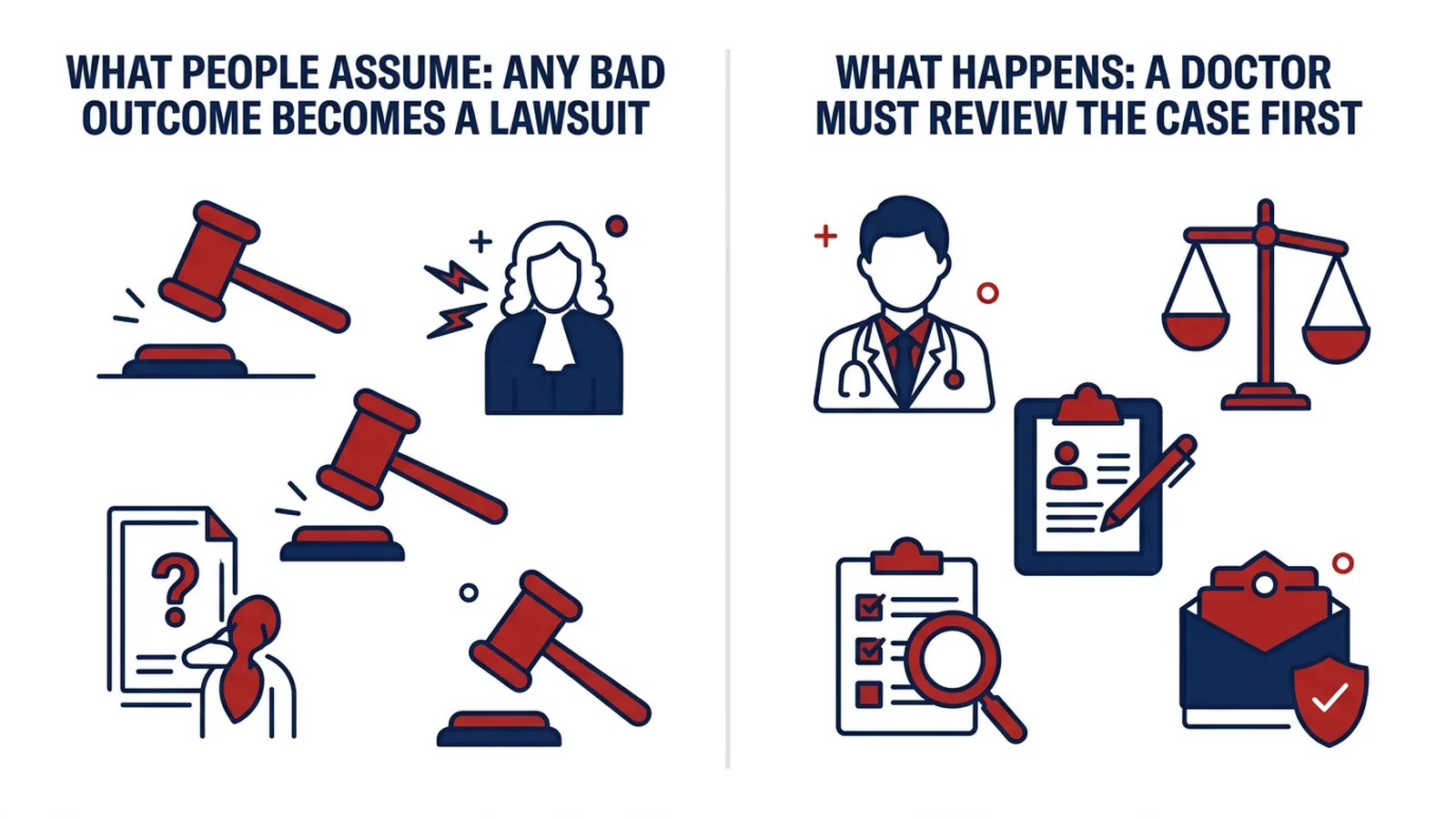
Start with ethics. A lot of people roll their eyes when a lawyer says that word. Lawyers are bound by ethics anyway, and the lawyers I know and deal with take that professional responsibility seriously. "We're officers of the court. We can't bring cases that don't have merit."
The word that matters here is what we call meritorious. A meritorious case has a real basis. Its opposite is a frivolous one, and a lot of people throw the phrase frivolous lawsuit around without knowing it is a legal term for a case that has no merit. The way I describe the safeguards is this: "The medical malpractice system has checks and balances in it to make sure that cases are what we call meritorious."
The first check is another doctor. Before a malpractice case can go forward, a practicing doctor who is familiar with the standards of care and the medical literature has to review the medical records. That doctor also has to be willing to come into court and say that what was done was wrong. The doctor also signs what we call a certificate of qualified expert, a signed statement that the doctor has reviewed the records, practices in the area of medicine involved, and is familiar with the standards of care. A malpractice case generally cannot go forward without it, and the statute sets the window for filing it.
People often assume an expert can be bought. "People think, you just pay an expert and they'll say anything. There are safeguards." One safeguard is who the expert can be: a doctor who is still practicing, and one who cannot devote a whole career to testifying in cases.
The statute behind this is the law, and it should be read as the law and not as my opinion. Under Maryland Courts and Judicial Proceedings section 3-2A-04, unless the only issue in a claim is lack of informed consent, a claim shall be dismissed, without prejudice, if the claimant fails to file, within the time the statute sets, a certificate of a qualified expert attesting to a departure from the standards of care and that the departure was the proximate cause of the alleged injury. The certificate is filed with a report of the attesting expert attached. The same section provides that a party may not serve as a party's own expert, and that an expert who attests may not have devoted more than twenty-five percent of professional activities to activities that directly involve testimony in personal injury claims during the twelve months before the claim was first filed. Chapter 10 takes the certificate apart step by step.
The certificate works as a quality control step, because a doctor has looked over the case first. It also cuts in a direction families should understand. If we cannot get a doctor to say the other doctor did something wrong, we cannot move forward on the case.
The second check is a judge. At any time, the other side or a judge can question whether a case is legitimate. The rules that guide Maryland courts, what we call the rules of civil procedure, include what are called bad faith lawsuits. As I describe those rules, when there is a question about whether a case was brought in bad faith, "the system has safeguards, like I keep saying, for a judge to say, no, this case is not legitimate."
That is why, on ethics and on the rules, I call the picture of lawyers like me unfounded.
The practical reason a lawyer cannot afford flimsy cases
The practical ground may persuade a skeptic faster than any rule. A medical malpractice case is enormously expensive to bring. Lawyers like me take these cases on what is called contingency, which means we do not get paid unless we win. If we lose, the money that went into the case is gone.
Let's suppose a lawyer puts together a case only because he thinks there is money in it. He has to spend a great deal of money on that case, and the other side is very smart. The defense lawyers are among the smartest I have ever come across. Put those two facts together and the result is easy to see: a lawyer who puts together flimsy cases and has to spend all that money is not going to be in business that long. As a practical matter, the cases are too expensive for it to work any other way.
It was different when I started. As a young lawyer, a malpractice case came into the office where I worked, and my boss offered it to me. In those days the cases were not as expensive as they are now, so a young lawyer like me could take one on, and I did, with some good mentorship. I found that it was work I liked, and that was where my career in this area started. Today the cost is a fact a lawyer in this work has to face before anything else.
Turning callers away, and what I tell them
Baltimore is a small place for the lawyers who do this work. We call it Smalltimore. I think all medical malpractice lawyers have the same experience, because "we all share each other's information. We're not necessarily friendly, but we're colleagues."
That shared experience says the same thing about the callers. A caller gets one of two answers. Either there is no malpractice, and we do not think the doctors did anything wrong. Or there is not enough injury to support a case. A person who was injured and then got well does not have much of a case to bring, because of how expensive a case is.
A bad outcome is not the same thing as malpractice, and most of the time a bad outcome is not medical malpractice at all. Some calls are hard, too. Sometimes, in a misdiagnosis situation, we cannot prove that what the doctor did was wrong.
Let's suppose the call is about an X-ray that a doctor read as normal. We gather the films ourselves and have a radiologist who consults with us review them. Sometimes the answer is yes, this was medical negligence, and the doctor did not do what he or she was supposed to do. Sometimes it comes back as a judgment call, a very hard call to make. We know now in hindsight that it was cancer, but looking at it at the time, the doctor may tell us it was a judgment call. That is how I describe proving the difference between a medical negligence case and a judgment. And because of it, "we have a responsibility that when we bring a lawsuit, that we have to make sure that that case stands on an excellent foundation."
When the answer is no, I tell the caller why. I think of that as a service, as funny as that may sound. We are telling most people why the healthcare system did the right thing by them and why they do not have a case. Sometimes they are disappointed to hear it.
The most gratifying response I get comes from callers I cannot help. Some of them say, "I wish I had a case, but you're the only lawyer who took the time to listen to me and to explain it." In my experience, a person who calls a lot of lawyers mostly gets no clarity about why a lawyer does not want the case. They call one after another and have no sense of the reason. When I finally explain it, there is a sense of relief, because "at least they can close the door on that chapter and go on with their lives, even if they can't bring a lawsuit."
Some callers have a problem that has nothing to do with medical malpractice. They were hurt at work, or they want to file for disability, or they have an employment issue. When I have someone to send them to, I do that. "That's not what I do, but here's somebody that I can send you to that can help you."
Where the idea of the suing type comes from
A lot of people arrive believing something they heard long before they called me. As I see it, much of it traces back to what we call tort reform. Insurance companies and the associations that speak for them put a great deal of money into tort reform, in Maryland and across the country. In my view these are insurance companies that want access to justice narrowed or closed. "They don't want people bringing lawsuits." Social media lets them take that message straight to the public.
The McDonald's hot coffee case is the example many people know. People hear that someone said the coffee was hot and spilled it, and they stop there. I am not going to retry that case here, but when you look at it in detail, I believe the evidence showed that McDonald's was much more responsible and more liable than people think. "Nobody wants to go behind those headlines." And so here come lawyers who want to sue for anything and get money for anything. I think those messages resonate with people.
Clients who call me sometimes tell me, "I'm not the suing type." Others say they have not sued anybody before. They say it almost to pre-empt something, I think because they believe some of these misconceptions themselves. I think the main reason the message has spread is that these organizations have the funds and the ability to get it out.
The lottery idea belongs to the same story, and I have called it bad press and propaganda. In all my years of taking these calls, nobody has phoned me with great news. What they understand is that they will need money to pay for what insurance does not cover and what disability payments do not cover. That is a conversation about care, and a lottery has nothing to do with it.
Doctors are not my enemy
Here is the part I most want a family to hear, so I will say it plainly: "I love doctors, I don't hate doctors, I have doctors who are my friends." They understand what I do.
That first malpractice case did more than start a career. I found that I liked the medicine itself: I like the whole science of it. I'm a big proponent of innovation. I'm a big proponent of robotic surgery, and of anything that can help people.
I will not pretend that all lawyers abide by ethics, because there are lawyers who do not, as in any other profession. What I can speak to is what I see: "my experience is the people that I associate with and deal with, we all feel very strongly about all the things that I just said."
My target is the system, and the accountability a family is owed. I do not say that lightly, because a person's relationship with their doctor is one of the most trusted relationships they have. You are putting your life in their hands. When a mistake happens, here is how I see it: "I think the only way that we can get that accountability is to bring a lawsuit."
None of the checks in this chapter makes the mistakes themselves go away. Speaking from where I sit, "I'm not seeing that there's been much of a change in the frequency of medical mistakes." That is why the checks matter to me. A case that clears them has already been looked at by a practicing doctor, and that is the kind of case I want to bring.
Common Questions
- Can a lawyer file a malpractice lawsuit against any doctor?
- No. A lawyer cannot file one against just anybody for anything. Another doctor has to review the medical records, be a practicing doctor familiar with the standards of care, and be willing to come into court and say that what was done was wrong. I think of that as a safeguard, because "just because we can doesn't mean that we should." Chapter 10 covers the certificate in detail.
- Why do malpractice lawyers turn down so many cases?
- Most bad outcomes are not malpractice. A lawyer turns a case down when the doctors did not do anything wrong, or when there is not enough injury to justify a case that is so expensive to bring. Not every case is medical malpractice, and not every misdiagnosis is. A case has to stand on a solid foundation before it is filed.
- Why is a malpractice case so expensive for a lawyer to take on?
- A malpractice case is enormously expensive to bring, and lawyers like me take these cases on what is called contingency, which means we do not get paid unless we win. A lawyer who loses a case loses the money that went into it. The expense falls on the lawyer, and the defense lawyers on the other side are smart.
- What is a frivolous lawsuit in a malpractice case?
- A frivolous lawsuit is a legal term for a case that has no merit. A lot of people throw the phrase around, but a malpractice case has checks and balances meant to make sure the case is what we call meritorious. A practicing doctor has to sign a certificate of qualified expert, and the other side or a judge can question whether a case was brought in bad faith.
- How soon will a lawyer tell me whether I have a case?
- A no can often come on the first call, and a yes takes months. Callers want to know, "do I have something or I don't?" Confirming a case takes months of investigation: going through the medical records with a fine tooth comb, building the timelines, and consulting with doctors who review them for the standards of care.
Chapter Reflection
Put the pieces side by side and the picture of a lawyer hunting for doctors to sue does not hold. Ethics bind me. A practicing doctor has to put a signature on the case. A judge can say a case is not legitimate. The cost of a weak case lands on the lawyer who brings it. A bad outcome is not enough, and a case needs a foundation before anyone files it. Those same checks are the reason my answer to most callers is no, and the reason I explain it. A no from a careful lawyer carries information, and sometimes the information is that the healthcare system did right by you. For the callers who clear these gates, the work is only beginning. What the first conversation with your lawyer looks like, and the investigation behind it, is where the checks in this chapter first go to work, and it is where Chapter 7 begins.