
The Certificate of Qualified Expert: Maryland's Safeguard Against Weak Claims
A lot of people give medical malpractice a bad name, and the reputation lands on lawyers like me. Here is the belief as I hear it put: "They say, well, a lawyer like myself can just file anything, they can put anything in court. That's not true." Maryland does not work that way, and the reason is a document with an awkward name.
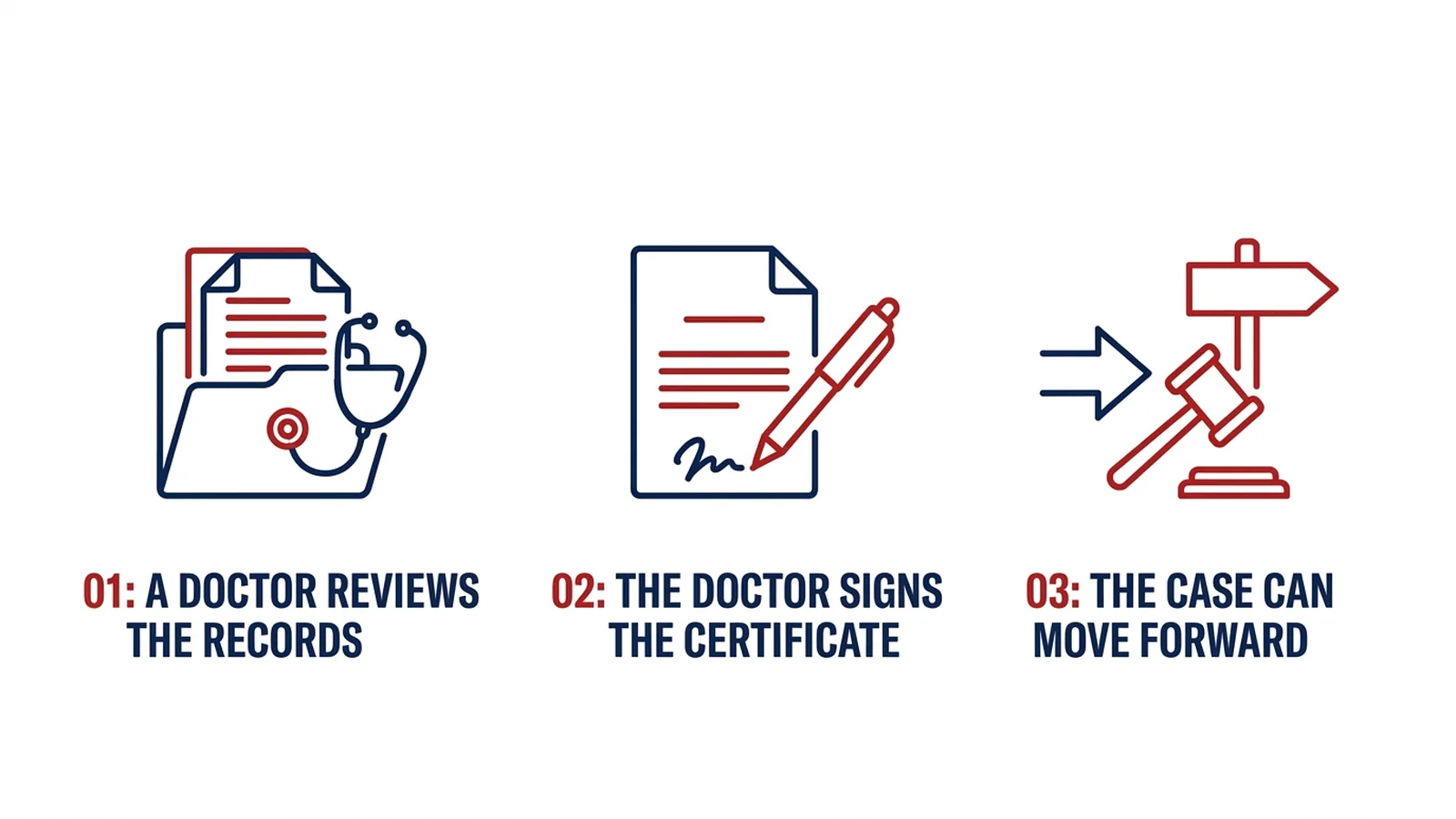
That document is the certificate of qualified expert. In plain terms, another doctor has to review the medical records and put a signature behind the claim that the care fell short, and that it caused the injury. Without it, a malpractice case generally does not move. This chapter takes that one safeguard apart: why a lawyer cannot just file whatever he or she likes, what the certificate says, who is allowed to sign it, what the Maryland statute says about its timing, and what happens when the paperwork is late or wrong.
Like I keep saying, the medical malpractice system has checks and balances built into it, and Chapter 6 introduced several of them. This chapter looks closely at one. Where this chapter describes what the law requires, I label it as the statute. Where it describes how I see the certificate, I say so.
And it gives people the comfort to know that the system is going to work, that there are safeguards, and that lawyers just can't file lawsuits against anybody for anything. Because just because we can doesn't mean that we should.
What stops a lawyer from filing just anything
Start with the question behind the belief: can a lawyer put any complaint in front of a court and see what happens? In Maryland malpractice cases the answer is no, and the check does not come from the lawyer's conscience alone. As I put it, "We have to have another doctor look at the medical records, be familiar with the literature, be a practicing doctor to be able to come into court and to say that what was done was wrong."
Let's suppose a lawyer has a hunch that a hospital did something wrong. The family is hurting, and the lawyer believes them. But the lawyer cannot find a single practicing doctor who will look at those records and say the care fell below the standard. Without that doctor, we cannot move forward on a case. The hunch stops there. A strong feeling about a case is not a substitute for a doctor's review of it.
Before that doctor can come to court, there is a step in between. The doctor has to be willing to sign what we call a certificate of qualified expert. It is a detailed document, and I say more about its contents in the next section. For now, the point is that a doctor has to review the records and sign it, and that the certificate is filed with the lawsuit or within the window the statute allows (Courts and Judicial Proceedings section 3-2A-04(b)). I put it flatly: "A medical malpractice case can't go forward without it."
I need to add one qualification, because the law does. The statute that sets the requirement, Maryland Courts and Judicial Proceedings section 3-2A-04(b), begins with an exception: it applies unless the sole issue in the claim is lack of informed consent. So the accurate version is that the certificate is generally required. A claim built only on informed consent is the exception the statute names.
Ethics matter here too, and I take them seriously. We're officers of the court, and as I say it, "We can't bring cases that don't have merit." A lot of people throw the word frivolous around. It is a legal term, and it describes a case without any merit. The certificate is one of several checks aimed at that problem, and it is the one that puts a second doctor's name on the question, filed with the lawsuit or within the window the statute allows.
What the certificate says and who is allowed to sign it
I describe the certificate as a very detailed document that the doctor signs. The doctor is saying that he or she reviewed all of the medical records, practices the kind of medicine that matters in the case, and is familiar with the standards of care and with the medical literature. A lot of people want to know what that standard of care means. It is what we call the nationally recognized guidelines of what doctors should and should not do. In my description, the certificate is specific about two things: what those standards are, and how the doctor being sued departed from them.
The statute puts the content in its own words. Under Courts and Judicial Proceedings section 3-2A-04(b)(1), the certificate attests to a departure from standards of care, and that the departure is the proximate cause of the alleged injury. Proximate cause is the legal phrase. The plain-language version, in my words, is that we have to prove that the violation of the standard of care caused the injury in question. The statute also directs that the attorney file the certificate with a report of the attesting expert attached, and that discovery is available as to the basis of the certificate (section 3-2A-04(b)(3)). In other words, the other side is entitled to look behind the signature.
Who counts as a qualified expert is spelled out as well. These are statements of the statute, not of me. Under section 3-2A-02(c)(2), for a claim filed on or after January 1, 2005, the expert must have had clinical experience, provided consultation relating to clinical practice, or taught medicine in the defendant's specialty or a related field of health care, or in the field in which the defendant provided care or treatment to the plaintiff, within 5 years of the date of the alleged act or omission that gave rise to the claim. Where the defendant holds a specialty credential from a certifying board, the expert generally must hold a matching credential in the same or a related specialty. The statute lists two situations where that matching requirement does not apply: when the defendant was treating the plaintiff for something unrelated to the area of the defendant's credential, and when the expert taught medicine in the defendant's specialty or a related field.
The statute also says who cannot sign. Under section 3-2A-04(b)(7), a party may not serve as the party's own expert, and the certificate may not be signed by a party, by an employee or partner of a party, or by an employee or stockholder of a professional corporation of which the party is a stockholder.
What I tell people about these doctors comes from the same place. "These are practicing doctors, they have to meet very strict guidelines under Maryland law." They have to be practicing, and they cannot make a career out of testifying. The statute supplies the measuring stick for that last point. Section 3-2A-04(b)(4) says the health care provider who attests may not have devoted more than 25% of the expert's professional activities to activities that directly involve testimony in personal injury claims during the 12 months before the claim was first filed.
This is why I push back on one idea in particular. People think you can pay an expert and the expert will say anything, and I push back on that because there are safeguards. A doctor who signs a certificate has to fit the statute's description, and the signature is attached to a report the other side can examine.
In a birth injury case, the doctors we consult are practicing obstetricians or other specialists. They go through the medical records together with us and help determine whether the standards of care were met.
What the statute says about timing
Now to the deadlines. The details in this section are the statute speaking, and I cite the section each time so you can read it for yourself.
The statute sets the clock for the certificate at 90 days. Under Courts and Judicial Proceedings section 3-2A-04(b)(1)(i), a claim or action filed after July 1, 1986 shall be dismissed, without prejudice, if the claimant or plaintiff fails to file the certificate of a qualified expert with the Director within 90 days from the date of the complaint. The Director, in the statute's own definition, is the Director of the Health Care Alternative Dispute Resolution Office (section 3-2A-01(d)). The claimant must also serve a copy of the certificate on all the other parties or their attorneys of record.
The statute then makes room for narrow relief. If the limitations period for the claim has expired, and the failure to file the certificate was neither willful nor the result of gross negligence, the panel chairman or the court shall grant an extension of no more than 90 days (section 3-2A-04(b)(1)(ii)). Section 3-2A-04(b)(5) adds that an extension of the time allowed for filing the certificate shall be granted for good cause shown.
The certificate is not only a plaintiff's obligation. Section 3-2A-04(b)(2)(i) provides that a claim may be adjudicated in favor of the claimant on the issue of liability if the defendant disputes liability and fails to file a certificate of its own, attesting either to compliance with standards of care or that any departure was not the proximate cause of the injury, within 120 days from the date the claimant served the plaintiff's certificate. If the defendant does not dispute liability, no defendant's certificate is required (section 3-2A-04(b)(2)(ii)).
The deadline for the lawsuit itself is a separate subject, and Chapter 11 takes it up. What I want you to hold onto here is that the certificate has its own clock, and the clock is written into the law. As I say it, "We are bound by rules. And rules tell us certain deadlines when things have to be submitted into court." A lawyer like me has to know both clocks and meet both.
A quality-control inspection of the case
The name itself is a mouthful. As I put it, "That sounds like a lot, tongue twister." What it means is that a doctor has to be willing to put in writing, very specifically, what the standards of care are and how the doctor we are bringing the lawsuit against violated them.
I think of it as a safeguard. It means another doctor has inspected the case for quality and said the case has merit. Meritorious is the word we use for a case with merit. It is the opposite of frivolous. The doctor is not only willing to sign. As I describe it, "They're willing to raise their hand in court and to swear that what they are about to say is the truth and nothing but the truth, and this is their opinion, and they stand by it." The certificate is a signed document with the expert's report attached. The oath comes later, when the doctor testifies in court.
I have said it plainly: "The certificate of qualified expert, I think, is an excellent safeguard." The safeguard matters to families too. In my words, it "gives people the comfort to know that the system is going to work, that there are safeguards, and that lawyers just can't file lawsuits against anybody for anything."
That comfort has a practical side. Another physician outside my office has looked at the records, practices in the kind of medicine that is relevant to the case, and is prepared to put a name to the conclusion. And if we cannot find a doctor willing to do that, the case does not go forward.
When the certificate is late or wrong, and the case that still needs one
The rules on timing are strict, so here is a hypothetical. Let's suppose you have the greatest case, and you file your lawsuit too late, say on the first day after the deadline. You could have the greatest case in the world, but it is thrown out because it was not filed on time. The certificate works the same way. "You could have the greatest doctor, the best doctor, the biggest expert, the only expert in this area of medicine. But if you file it too late or you don't file it properly, you might as well just throw it in the trash because it's going to be worthless."
As I see it, you must have an experienced medical malpractice lawyer who knows the rules and will file things on time. "Because if things are even one minute late, it's like they're a hundred years later." That is my warning in practical terms.
The statute does contain some narrow relief. These are the law's words, and I report them as they are written. Dismissal for a missing certificate is without prejudice under section 3-2A-04(b)(1)(i). Beyond the extensions in the last section, section 3-2A-04(b)(4)(iv) says that if a court dismisses a claim or action because a qualified expert failed to comply with the requirements of that subsection, then unless there is a showing of bad faith, a party may refile the same claim before the later of two dates: the expiration of the applicable period of limitation, or 120 days after the date of the dismissal. Subparagraph (v) adds that a claim may be refiled this way only once.
Each of those provisions has conditions written into it: an expired limitations period together with a failure that was neither willful nor grossly negligent, no showing of bad faith, a single refiling. Even so, these are narrow exceptions, and the safest course is a certificate filed correctly and on time.
The certificate also applies to the cases that seem easy. A lot of people assume that a wrong-site surgery is automatic. Many of them figure that a surgeon who operated on the wrong side means the procedures can be skipped. But that is not how it works. If a case involves a wrong knee, even though it sounds obvious, we still have to get another doctor to review the medical records. The wrong knee does let us state an obvious error, which has a lot of jury appeal, and as I see it a case like that is probably going to settle out of court because it is so open. To get to that point, we still have to follow all of the laws and procedures of a medical negligence case in Maryland, and the certificate is one of them.
Common Questions
- What is a certificate of qualified expert in a Maryland malpractice case?
- It is a signed certificate in which a qualified doctor attests that the care departed from the standards of care and that the departure caused the alleged injury, with the expert's report attached (Courts and Judicial Proceedings section 3-2A-04(b)). I describe it as a detailed document showing the doctor reviewed the records and knows the standards and the literature. It is generally required, except where informed consent is the only issue.
- Who can sign a certificate of qualified expert in Maryland?
- Under the statute, the signer must have recent experience in the defendant's specialty or a related field, and a matching specialty credential when the defendant holds one, with stated exceptions (section 3-2A-02(c)(2)). A party, or a party's employee or partner, cannot sign (section 3-2A-04(b)(7)). In my own summary, these doctors have to be practicing and cannot devote their whole lives to testifying. The statute caps testimony work at 25% of professional activities in the prior 12 months.
- How long does a family have to file the certificate in Maryland?
- Under the statute, a claim is dismissed without prejudice if the certificate is not filed within 90 days from the date of the complaint (section 3-2A-04(b)(1)). An extension of up to 90 days is available only if the limitations period has expired and the failure was neither willful nor grossly negligent; a separate provision allows one for good cause shown (section 3-2A-04(b)(5)). Confirm the dates for a particular claim with a lawyer.
- Does a wrong-site surgery case still need a certificate of qualified expert?
- Yes. A wrong-knee case may sound open and shut, but "You have to have the same procedures that go into it." Another doctor reviews the medical records, signs the certificate, and is willing to come to court and say it was malpractice. The obvious error carries a lot of jury appeal, and the safeguards still come first.
Chapter Reflection
A family can get a good deal of comfort from this chapter, and a good deal of caution. The comfort is that in a Maryland malpractice case, a practicing doctor outside my office reviews the records and signs a certificate that the statute describes in detail, filed with the lawsuit or within the window the statute allows. The caution is that the safeguard has a clock and a form, and a case with a strong expert can still be undone by paperwork filed late or filed wrong. Both things are true at once. The next chapter turns to the larger clock, the time a family has to bring the lawsuit at all.