
What a Birth Injury Case Is, and Why It Is Different From Other Malpractice Cases
Of all the malpractice cases a lawyer like me can take, birth injury cases are the toughest for me to handle. A family goes to the hospital looking forward to a moment of joy, and something goes wrong.
When I talk with families about this, I use the term straight talk. It means I tell everybody like it is, and that starts with a plain answer to a question a lot of people have never had answered: what exactly is a birth injury case?
This chapter gives that answer in my own words. It covers the definition I work from, what I have seen a permanently injured child's life can involve, and why these cases are built differently from the surgery and diagnosis cases that follow in Chapter 4. The records, the deadlines and the people named in a lawsuit each get a chapter of their own later on (Chapters 8, 11 and 12), so here I stay with the basic question of what a birth injury case is.
there are so many warning signs that happen during birth that get ignored or blown off or not recognized.
Where a moment of joy turns into a disaster
When I describe the work I do, I start with the cases that call me most often. By far the most frequent call I get has to do with a surgical complication. Anesthesia errors, misdiagnosis and failure to diagnose are part of what I see too, and Chapter 4 walks through all of them. Birth injury sits apart from those. I put it this way: "These are the toughest cases, at least for me, to handle because you're dealing with something where parents' life is turned upside down. A moment of joy and anticipation of joy becomes something that's a disaster."
It is sad even for me to talk about, and I have been at this a long time. My own start in medical malpractice came when I was a young lawyer at a law firm. Medical malpractice was not my practice area at all. I was exploring whether some other practice area might interest me, and a medical malpractice case was in the office. My boss asked whether I wanted to take it on. In those days these cases were not as expensive to bring as they are now, so a young lawyer like me could take one. I had some good mentorship, though what I knew about the work then was thin.
That case is where it started. I found it was something I liked. I do like medicine, and I like the whole science of it, and I am still grateful to the mentor who allowed me to have that experience.
The delay in delivery at the center of a birth injury case
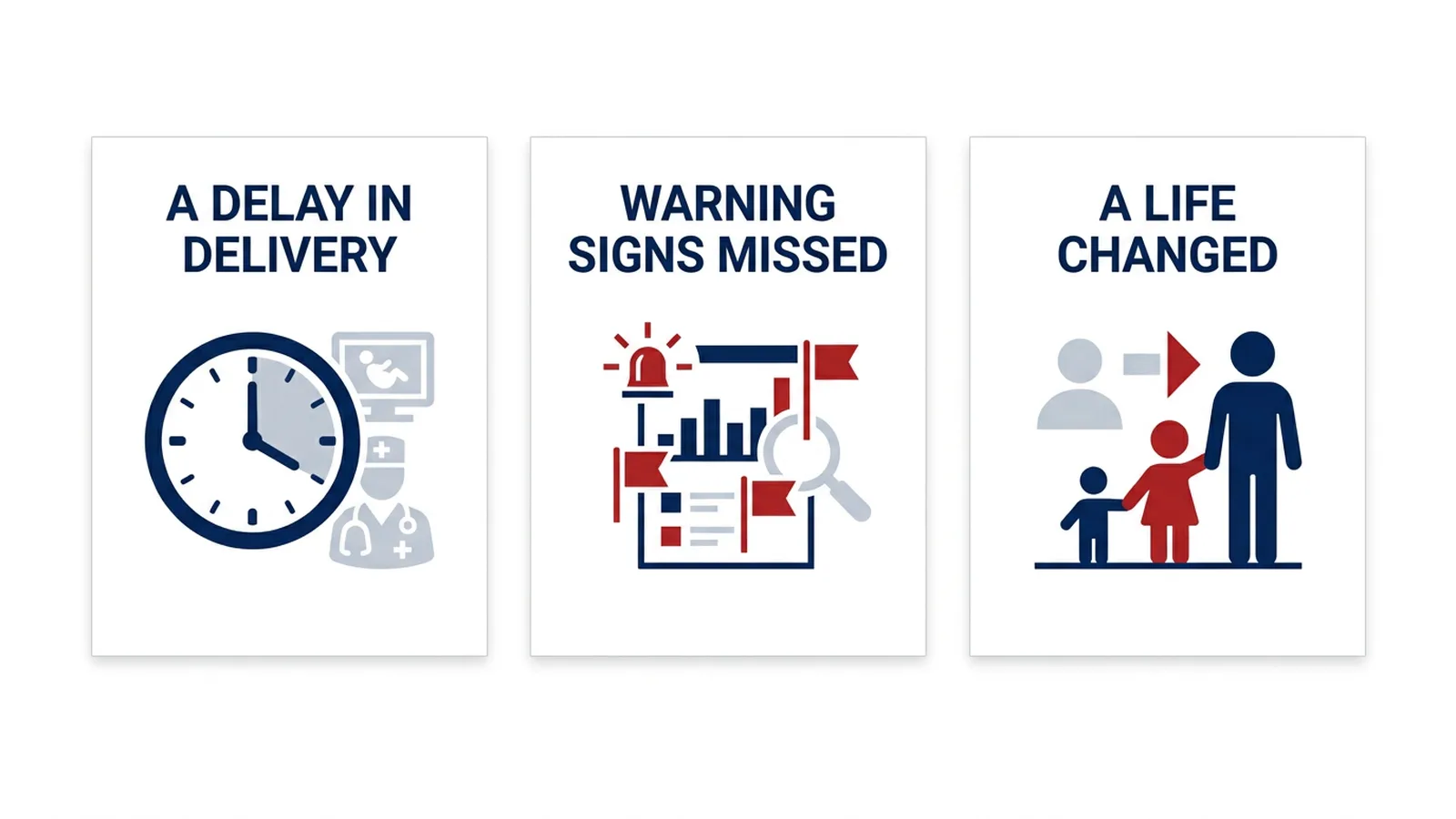
I was introduced to a birth injury case as a young lawyer, and a lot of people still do not know what one is. So let me give you the definition I work from. Here is how I explain a birth injury case: "It's a delay in delivery. It's the failure to deliver a baby early enough before the baby suffers permanent brain damage."
The weight of that definition sits on two words, early enough. In many of the cases I have, a birth injury case is about timing, about whether a baby was delivered soon enough.
Let's suppose a lawyer brings a lawsuit in a birth injury case. The allegation is that the doctor and the nurse did not deliver the baby early enough, and that the baby was deprived of oxygen. Now that baby has permanent cerebral palsy or brain damage. That is the shape of the claim as I frame it: a delivery that came too late, a baby short of oxygen, and an injury that does not go away. Who gets named in a suit like that, and how responsibility is divided among them, are questions for Chapters 12 and 16.
Three ways a warning sign gets lost during birth
Birth is full of signals, and in the cases I take, many of them were missed. Some were seen and set aside. Some were waved off. Some were never recognized as signs at all.
To understand what a sign looks like, it helps to know what a mother sees in the room. When a mom goes into labor, belts are put around her stomach. One measures the contractions and the other measures the baby's heart rate, and that, in my words, is "the signal from the baby, whether our baby's doing well or not well inside mom."
The record of that signal is what we call the baby monitor strips, or just the baby strips. In my view they are the biggest piece of evidence we can use, because they can show when an injury occurs, whether it came from a delay in delivery or from something sometime earlier. How an expert reads them, line by line, is the subject of Chapter 8.
None of this means that every hard labor is malpractice. Chapter 1 covered this: there are risks to every birth, and an injury from one of those risks does not by itself mean medical malpractice. We go back to the standard of care, which is the term we use for the nationally recognized guidelines about what doctors should and should not do. Then we have to prove that a breach of that standard caused the injury in question.
The life that follows a permanent injury
In many of the cases I have, the child is permanently brain damaged. I tell families what that can mean in plain words. The child "may not walk or talk, may not be able to feed himself or herself, may not be able to see or hear, may be in a wheelchair, maybe bedbound for the rest of your child's life." I ask people to imagine the emotion that goes into that, and to imagine how devastated a family is.
Fear of the cost belongs in that picture too. Many of my clients who have children like this need "24-hour medical care, nursing care. That's very expensive." In my observation, with modern medicine, children who have these severe brain injuries are living a lot longer than they did when I started practicing law thirty-five years ago, and I see that as one reason the costs are so large.
I cannot turn back the hands of time. I wish that I could. What I tell my clients is that I can't change what happened, but I can make sure we hold the system accountable. Chapter 14 takes up what a family can recover, and Chapter 19 takes up accountability.
A child's injury lasts a lifetime, and Maryland treats the time to file for a child differently from the time for an adult. I think the time limits for children in Maryland are very generous, and I tell people that many states do not have Maryland's long limit for children, and many have very restrictive limits. That matters in birth injury cases. The law itself, which is not my working rule, is written in Maryland Courts and Judicial Proceedings section 5-109. Subsection (a) says an action for damages for an injury arising out of a health care provider's professional services must be filed within the earlier of five years of the time the injury was committed or three years of the date the injury was discovered. Subsections (b) and (c) of the same section set when those periods begin to run for a young child. Because the date depends on the particular child, a lawyer has to confirm it. I take up deadlines in Chapter 11.
A thousand-piece jigsaw puzzle: how the pieces come together
A birth injury case is different from a typical malpractice case because of the level of detail it takes to see the subtle signs that something was not going right. Compare it with a surgery case: "It's not going to be something like in a surgery case where you can say, well, the doctor cut the wrong organ or the doctor cut an artery, and it's very clear and obvious. In birth injury cases, there are very subtle signs that maybe something is not going right."
The way we handle that is that "we put together this, I'll call it, a thousand-piece jigsaw puzzle." Each piece has to come from somewhere, and I look for them in three places.
Step one is the interview. I spend a lot of time in that first conversation, and it is a two-way street. I ask a lot about the labor, a lot about the prenatal care, a lot about what happened afterwards and a lot about what the child is like. The family asks me questions too, and we get all the information down.
Step two is the medical records. I go through them with a fine-tooth comb and build timelines of when things happened. By looking at those records, we can tell whether a delay in delivery caused brain damage or cerebral palsy.
Then we consult with medical doctors, practicing obstetricians or other specialists who go through the records together with us. They help determine whether the standards of care were met, whether a violation of those standards caused injury, and how severe and how permanent that injury is.
All of that takes a lot of work on the front end. It takes months of investigation before we can tell someone whether they have a case, and it is all in the preparation beforehand. On a first call I can often tell someone that there is no case. Confirming that there is one is slower.
A subspecialty that not many lawyers handle
Birth injury is a very specialized area inside medical malpractice. I describe it as "a subspecialty of medical malpractice that not a lot of lawyers deal with." The same point comes through in another way: "Not too many lawyers who do medical malpractice even do birth injury cases. There are so many factors that have to go into it."
The level of detail is the reason. A lawyer like me who takes a birth injury case is taking on the whole puzzle: the interview, the timelines drawn from the records, and the opinions of consulting doctors. That is what sets these cases apart from the cases in the next chapter.
Common Questions
- What is a birth injury case?
- I define the kind of birth injury case I was introduced to, and often see, as a delay in delivery: a baby not delivered early enough, deprived of oxygen, and left with permanent cerebral palsy or brain damage. Other birth injuries turn on other things, which Chapter 9 covers. Not every difficult birth qualifies. There are risks to every birth, so a lawyer has to prove that a breach of the standard of care caused the injury.
- How is a birth injury case different from other medical malpractice cases?
- The difference is the level of detail. In a surgery case the error can be clear, like a cut organ. In a birth injury case the signs that something was going wrong are subtle, so the work is gathering many small facts from the interview, the records and consulting doctors. I compare it to a thousand-piece jigsaw puzzle. Many malpractice lawyers do not take birth injury cases at all.
- How long does a family have to file a birth injury lawsuit in Maryland?
- A child gets far more time than an adult, which is why time limits matter so much in birth injury cases. Maryland Courts and Judicial Proceedings section 5-109 sets the limits for health care malpractice claims and delays the start of the clock for a young child. A lawyer has to confirm the date for a particular child. For an adult, the rule I use is three years from the date of the injury.
- How does a lawyer find out whether a birth injury case exists?
- It starts with a long personal interview about the labor, the prenatal care and what happened afterwards. Next comes a careful read of the medical records, with timelines built from them. Then practicing obstetricians or other specialists review the records with us to say whether the standard of care was met and whether a violation caused the injury. On a first call I can often tell someone there is no case, but confirming one takes months of investigation.
Chapter Reflection
Much of this chapter comes back to timing. In many of the cases I have, a baby needed to be delivered sooner, and the signs were there during the birth to be read. A family's life is turned upside down when they are missed, and it stays that way for as long as the child lives. The next chapter turns to the calls that reach me most often: the surgical mistake, the anesthesia error and the diagnosis someone dismissed as nothing.