
The First Steps a Baltimore Family Can Take After a Suspected Birth Injury
Birth injury is the part of my work that is hardest on me. In my own words, "these are the toughest cases, at least for me, to handle because you're dealing with something where parents' life is turned upside down." A family arrives at the hospital with a moment of joy and the anticipation of joy, and what follows can be a disaster. Everything in this chapter starts from that point: what a family can do once they begin to suspect it happened to them.
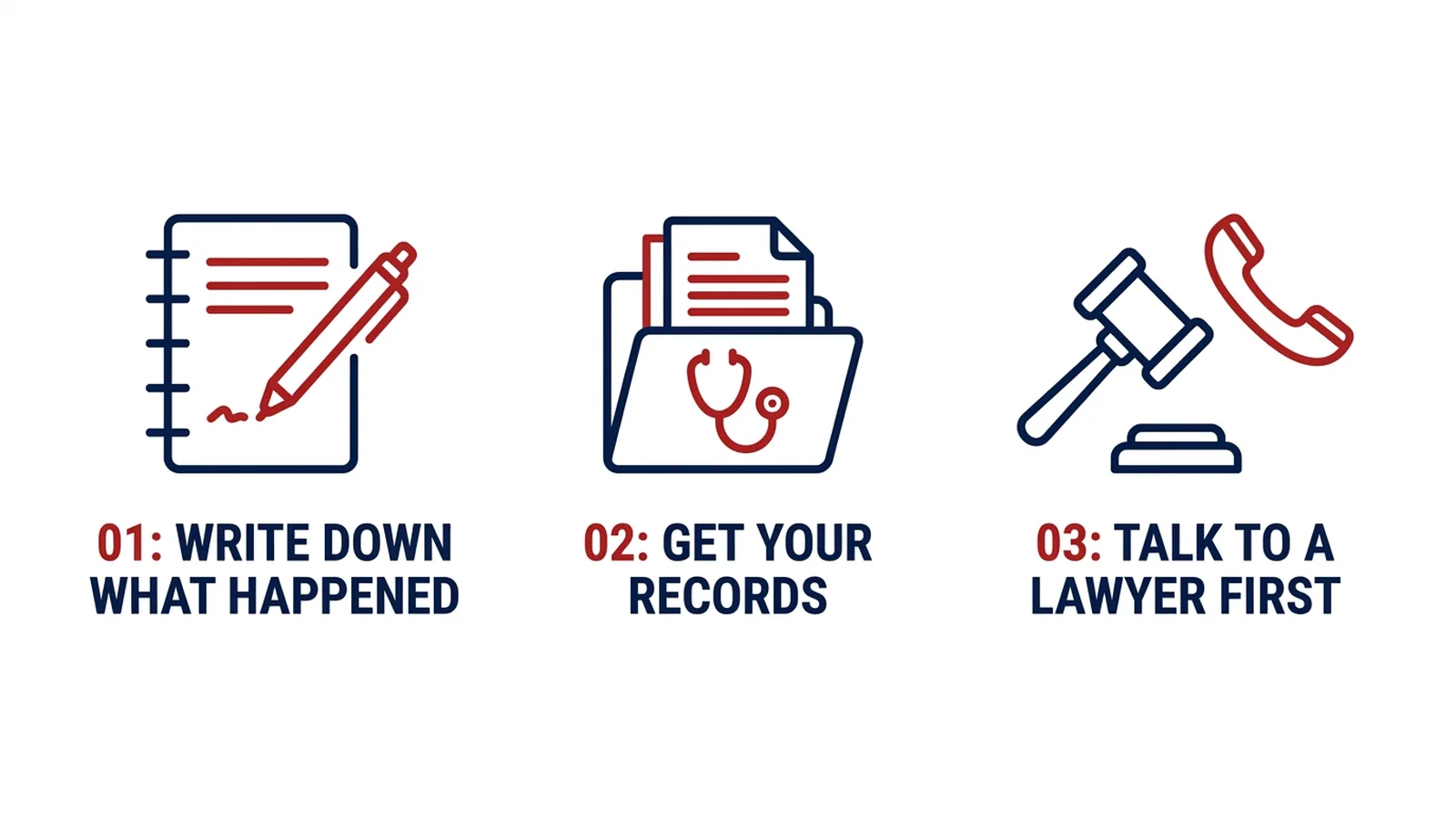
I tell everybody like it is, what I call straight talk, so here is the plan. There are three steps, and each of them is within reach. Write down what you remember. Get your medical records. Speak with a lawyer before you speak with the hospital. None of the three needs a law degree, and none of them requires you to decide whether you have a case. Whether a bad outcome counts as medical malpractice at all is the subject of Chapter 1, and what makes a birth injury case what it is, I explain in Chapter 3.
Before the steps, though, I want to start with a feeling, because many mothers who call me bring it into the call itself. It is the one thing I like to address right up front.
I tell them, I said, you didn't do anything wrong. You went to the doctor, you kept your appointments. You did what you were supposed to do.
What I say first to a mother who feels guilty
"Many mothers who call me, they feel guilty. They feel like they did something to cause this problem in their child." And the feeling follows them to the phone. A mother may expect that if she calls a lawyer, then the lawyer, the hospital and the lawyers for the other side will turn the blame around and aim it at her, and that she will hang up feeling worse than she did when she dialed.
Why begin there, in a chapter about steps? Well, because the fear is about the call itself, and a fear like that can stop a person before step one.
I am also careful about what I promise. "Now I can't change the way people feel, but I want to provide them some comfort and to have that conversation." A feeling like guilt does not leave because a lawyer says so, and I will not pretend it does. What I can do is make sure the conversation offers some comfort. I want a mother to know that she should speak to a lawyer, and that a lawyer like myself is not going to judge her or tell her it is her fault, because it is not.
The rest of that first conversation is a lot of listening. The lesson I took from my early years in practice is that what people are looking for is "someone to guide them with a calm hand." I do not talk over people. I let them tell their story, and I let them tell me everything they want to get off their chest. A lot of times they want to vent. Many of the people who call have been hurt by the medical system, and some of them feel ignored by it. They are mad and they are confused, and part of my job is giving them the space to say so.
Step one: write down who was there and what happened
Let's suppose a mother now believes that something happened to her child during the birth. The first step needs nothing but a pen and some time. She should put it on paper while it is fresh, and this is how I put it to families: "I'm not asking you to keep a journal while you're delivering, but if you now believe that something happened to your child, while it's fresh in your mind, take very good notes about what happened, when it happened, who was there, the names of the doctors, the names of the nurses, while that is fresh in your mind."
Notice how little that asks. A mother is not being asked to reconstruct a medical chart or to work out what went wrong. She is asked for five plain things: what happened, when it happened, who was there, and the names of the doctors and the nurses. The instruction even starts with belief, not proof. It says "if you now believe." You do not need to be sure of anything to begin.
The reason for the timing is built into the instruction itself, and I repeat it because it is the point: do it while it is fresh in your mind.
The hospital charts the times and the actions, down to "when the nurse comes in, when a nurse comes out, when a doctor comes in, when a doctor comes out." The chart is the hospital's account. Your notes are your own account, in your own words, and they do not need to look like a chart.
Those notes also give you something to bring to the first real conversation with a lawyer. When we sit down, I am going to ask you a lot about the labor, a lot about your prenatal care, a lot about what happened afterwards, and a lot about what your child is like. It is a two-way street, and you will have questions for me too. That interview, and the investigation behind it, are the subject of Chapter 7.
Step two: get your records through the health portal
The second step is easier than it used to be, and I am glad to say so. "It's not like it used to be, where medical records were in paper format and they had to be requested in paper format, and it took weeks and months to get medical records. Those days are gone." Now we have health portals through which patients can get their records. So the instruction is short: get your medical records through your health portal as soon as possible.
Why does a lawyer care so much about those records? Because I have called the medical record the Bible in a medical malpractice case. Chapter 8 returns to that image. The record holds the nursing notes, the doctor notes, the lab results, the X-ray results and the MRI results. As I see it, whatever is in that record is the core basis for the case, and I have said that the medical record is a lawyer's friend. How experts read a record, and what a delivery looks like on paper, are the subjects of Chapter 8. For now, the step is only to get it.
Maryland law speaks to the request as well, and what follows is the law, not me. Under Maryland Health-General section 4-309, if a health care provider knowingly refuses to disclose a medical record within a reasonable time but no more than 21 working days after the date a person in interest requests the disclosure, the health care provider is liable for actual damages. The same section also says a health care provider may not refuse to disclose a medical record on the request of a person in interest because that person failed to pay for health care the provider rendered.
Put the portal and the statute side by side and the picture is plain enough. The records are the core of a case, getting them is faster than it was, and the law sets a limit on a knowing refusal.
Step three: do not handle the hospital and the doctors on your own
The third step is the one I call the most important. "Do not try to talk to the hospital and doctors on your own." That covers talking about the case, trying to settle it, and trying to do it yourself. "You have to speak with an experienced medical malpractice lawyer." The reason is short. "Because the hospitals and doctors have people that do this every single day. You need somebody as an advocate on your side."
Now, what that instruction is, and what it is not. It is not a rule against settlement. I'm a big proponent of negotiating and trying to resolve a case out of court, so nobody should read the third step as a warning against settling. It is a warning against doing the negotiating alone, across the table from the people who, in my words, "do this every single day," when this may be the first time you have faced anything like it.
A second reason belongs to later chapters, though a sentence of it fits here. A malpractice case runs on rules and deadlines. In my words, "you must have an experienced medical malpractice lawyer who knows the rules and will file things on time." The certificate that has to come with a case is the subject of Chapter 10, and the clock a family is working against is the subject of Chapter 11.
Taken together, I tell families that doing the three things puts them in a much better position than skipping them. Step one costs a pen. Step two is a request through your portal. Step three is the call, which is why I began with guilt.
What peace of mind can mean for a family
Families sometimes want to know what all of this is for, and I give them an honest answer. I cannot turn back the hands of time, and I wish that I could. "Money sometimes just seems to be such a sort of a bittersweet or a hollow thing to talk about with people." What I can do, as I found over my career, is provide "at least some measure of comfort to people who've had this happen to them and their lives turned upside down."
What does compensation do, then? In my experience, "compensation allows people to kind of put their lives back together." Let's suppose that because of an injury a family needs therapies and other medical treatments that their insurance does not cover. Medical costs keep going up, and as I see it, so many people are being wiped out and having to file for bankruptcy because of them. That is the setting in which a family hopes to have the resources to meet those needs.
The peace of mind I mean is concrete. It is "giving them the peace of mind to know that they have the financial resources to be able to have their child at home versus having to be in some kind of institution." In my view, and I say it as my own opinion, those institutions are not great. If I can help a family reach that point, I get a lot of satisfaction from it.
None of this is a lottery. As I tell it, "Nobody who has ever called me in 35 years has said to me, Hey Frank, I got great news." What families understand is that they will need money to pay for things that insurance and disability payments do not cover.
When I talk about compensation that way, families understand that I am not judging them. "I'm not thinking that they're here for all the money." I know it from dealing with my clients for thirty-five years, not from my own life.
Common Questions
- What should I do first if I think my baby was hurt during birth?
- Three things, in order. Write down what happened, when it happened, who was there, and the names of the doctors and nurses, while it is fresh in your mind. Get your medical records through your health portal as soon as possible. Then speak with an experienced medical malpractice lawyer before you try to deal with the hospital or the doctors yourself. I call that last step the most important of the three.
- Can I get my medical records through a health portal after a delivery?
- Yes, and it is a lot faster than it used to be. Waiting weeks and months for paper copies, "those days are gone." Get your records through your health portal as soon as possible. If a provider knowingly refuses to release a record, Maryland Health-General section 4-309 sets a limit of 21 working days after a person in interest requests it and makes the provider liable for actual damages.
- Should I talk to the hospital myself before I call a lawyer?
- No. I tell families not to try to talk to the hospital and the doctors on their own, and not to try to settle a case or handle it themselves. The hospital and the doctors have people who handle this work daily, and you need "an advocate on your side." I'm a big proponent of negotiating, but I want an experienced lawyer in the room when it happens.
- Will a lawyer blame me for what happened to my baby?
- I will not, and I say so. Many mothers who call me feel guilty and fear being blamed, so I address it at the start of the first call. I want them to understand that, in my words, they should not feel that a lawyer like myself is going to judge them. I cannot change how a mother feels, but I can offer some comfort and give her the space to tell me everything she wants to tell me.
- Do I need to know whether I have a case before I start writing things down?
- No. The first step begins with belief, not proof: "if you now believe that something happened to your child." On a first call I can often tell a caller there is no malpractice or not enough injury. Confirming that there is a case is different. It takes a lot of work on the front end, and months of investigation, before a lawyer can tell a family whether they have one.
Chapter Reflection
Set the three steps side by side and they share one feature. None of them asks a family to be a lawyer, a doctor or a judge of their own case. A pen, a health portal and a phone call are all it takes, and the person holding them may still be carrying the guilt I started this chapter with. That is where I begin, because that feeling should not be the reason a mother does not make the call. What she can expect after the call is an honest matter too, and I will tell her straight: a very small share of the people who call me become cases. Chapter 6 looks at why that is, and at the checks the system builds in before a case is allowed to go forward.