
The chapters before this one deal mostly with proof. What the standard of care is, how a medical record is read, who signs the certificate of qualified expert, how long a family has to file, and who ends up named in the lawsuit. Those questions decide whether a doctor or a hospital did something wrong.
A second question sits right beside them. Let's suppose a lawyer proves that a doctor fell below the standard of care. That is a finding about what happened in a delivery room or an operating room. It is not money. A family whose child is going to need care for the rest of the child's life needs something more than a finding, and whether anything stands behind the people at fault is a question about insurance.
Nothing a lawyer does undoes the injury, and I wish it could. What I can do is give a family straight talk about whether a case has the resources behind it to help. This chapter covers why people picture the wrong source of money, how a birth injury case can rest on several layers of coverage, how the amount of insurance changes what a doctor is willing to risk at trial, and why we look for all of the coverage before telling a family what to expect. Chapter 12 explains who gets named in a lawsuit, and this chapter explains one reason that list matters. Chapter 14 turns to what a family can recover and what Maryland limits.
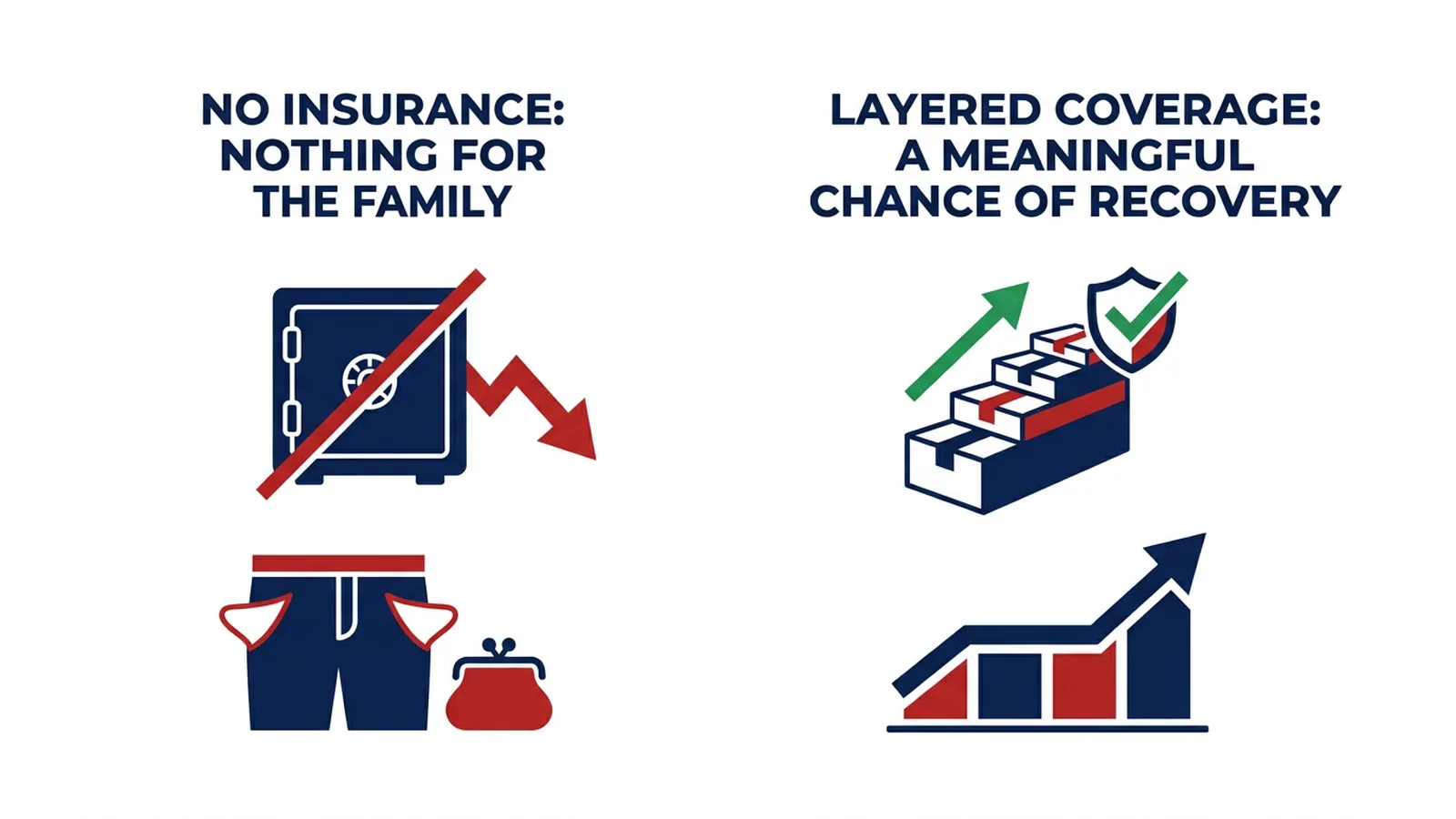
insurance is everything because you have to have adequate insurance to be able to tell your client that you have a meaningful chance of a recovery.
Insurance decides what a case can become
Much of the work in the earlier chapters answers questions about the past. Did the care meet the nationally recognized guidelines? Did a departure from them cause the injury? Is there a practicing doctor willing to say so in writing and in court? Insurance answers a different kind of question, which is what can be done about it.
A lawyer who tells a family there is a case is also telling them that something stands behind the people at fault. That something is coverage. Without it, a finding that a doctor fell below the standard of care is a finding that cannot pay for a single hour of nursing or a single therapy session.
The word adequate carries the weight, and it does not mean the same thing from one family to the next. A malpractice case is worth something different each time, because each client has different needs. Some are more injured than others. Some need more medical care or more medications, and some have lost a job or the chance of one. So adequacy is measured against the client.
That is also why a lawyer like me cannot treat the lawsuit as a way of making a point and nothing more. I have said that going after a doctor who has no insurance, or inadequate insurance, is not realistic, and the reason is easy to state: "there's not going to be any money for my client."
Picturing a rich doctor and the money a lawsuit can reach
A lot of people picture a malpractice case as a claim against one wealthy person. "People think, well, doctors are rich, I could just go get the money from a doctor." I understand why the picture is common, but it does not match these cases. In my words, "most of these cases go beyond what even any doctor would have in their personal assets."
To see why, start with what a family faces after a serious birth injury. Many of my clients with a child like that need round-the-clock medical and nursing care, and that is very expensive. Children with severe brain injuries are also living a lot longer than they did when I started practicing law, thirty-five years ago, and so the costs are enormous. A family in that position is frightened of those costs, and you can imagine how fearful a family is of those costs.
What the money can mean, as I see it, is peace of mind. It can mean a family knows they have the financial resources to keep their child at home instead of in an institution, and the institutions are not great. In thirty-five years, nobody who called me has said they had great news because they were injured and were going to get a whole lot of money. They understand that they will need money to supplement what their insurance does not cover and what disability payments do not cover.
The size of that need is the work of a specialized expert called a life care planner, who projects the therapies, the medications and the nursing care a person is going to need for the rest of life. Chapter 14 shows how that projection becomes a number a jury sees. For this chapter, the point is simpler. When I decide which names belong on a lawsuit, proper insurance is part of the reason.
A birth injury case can rest on several layers of coverage
Here is where a lawyer's due diligence starts to look complicated from the outside. A patient does not know all of the different corporate entities that a hospital or a doctor is part of. If you go to the emergency room, the doctors who treat you there are part of a separate corporation, and you have no idea about that.
Let's suppose a mother delivers with Dr. Jones. A doctor is usually part of what we call a corporate practice, so Dr. Jones may operate under a company I will call Babies Inc. That is one entity beside the doctor. Maybe a nurse was involved in the care, and the nurse may be part of a corporate entity too, one I have to discover. Then there is the hospital, and there may be corporate entities inside the hospital as well. A lawyer brings the lawsuit against the doctor and the doctor's corporate entity, then against the nurse, and then against the hospital and its corporate entity. The law also holds an employer responsible when an employee makes a mistake, with the caveat that a lot of doctors work for a separate corporation and not for the hospital.
Why does this matter for insurance? Because we have to make sure there is proper insurance, and each of these entities may carry a different policy. A lawyer who names only one of them may be looking at only one of the policies.
In birth injury cases, the layers can go further. There could be several layers of insurance, with more than one company insuring the hospital. In my words, we need to make sure we have adequate insurance coverage, and that is part of why a hospital is named, alongside the rule that an employer answers for an employee's mistake.
None of this is visible to a family in a hospital room. It is the reason a medical malpractice lawyer does the research on the entities before the lawsuit is filed, so the right parties and the right policies are in the case. Chapter 12 walks through the naming. The point to hold onto here is that each name on the lawsuit may bring its own coverage with it.
A doctor with a finite policy thinks hard about trial
Insurance does not only decide whether a case can be brought. It shapes what happens after the case is filed. In my words, "The amount of insurance does dictate settlement."
Let's suppose a doctor has only a finite amount of insurance, and the damages in the case far exceed it. Sit in the doctor's chair for a moment. That doctor is probably going to think long and hard about going to trial, and is going to want to resolve the case, because "they don't want to expose themselves to getting a judgment against them over the amount of insurance." It is hard to collect money from a doctor personally, but a court can still enter a judgment against an individual doctor, and no doctor welcomes that possibility. The gap between the policy and the damages is a form of pressure, and it pushes a case toward the negotiating table.
Whether a case can be resolved out of court is one thing the insurance helps decide. A trial puts the case in front of jurors, and the outcome is uncertain. "The trial you think you're going to try is not the trial that happens before you." A negotiated result leaves much more control with the people at the table. Once a case is settled, it is final. Even a jury win is not the end, because the other side can appeal, and an appeal can take years to work through the court system.
None of this makes a settlement certain. I have to be honest about that, because sometimes "the doctors and the hospitals and insurance companies are adamant and they want to go forward." The amount of insurance moves the conversation, and it does not end it. Like I keep saying, I tell my clients, let's manage our expectations. And whether to accept any number is the client's decision. If I bring a number to a client and the client does not think it is fair, the client has the right to say no thank you. Chapter 18 returns to who decides.
Looking for all of the coverage before promising a family anything
Because coverage shapes so much, the investigation has to include it. "We need to find the most insurance that we possibly can," because a birth injury case that succeeds can result in a recovery that can be significant, and the insurance has to be there to satisfy it. In a birth injury case, that means investigating all of the coverage so we can maximize the recovery for the family.
That search sits inside the larger investigation described earlier in this book. With some callers, I can tell on a first conversation that there is no case. With the ones I look into, it takes months of investigation before we can tell someone whether they have one, and coverage is one of the things we need to understand along the way.
A second reason coverage matters to a lawyer is that a malpractice case is enormously expensive to bring. Lawyers like me take cases on what's called contingency, which means we do not get paid unless we win. If we lose a case, the money we advanced is gone. That is part of why not every caller becomes a case: either there is no malpractice, or there is not enough injury to substantiate a case, given how expensive a case is. And in a case against a hospital, I need adequate insurance coverage behind the claim before I can pursue it.
This is where straight talk matters. I tell everybody like it is. If the coverage is not there, a family deserves to hear that plainly, along with the reason, and a no from a lawyer who took the time to explain it gives people something useful. If the coverage is there, the family can hear that too, with the same honesty about what comes next. A family whose life has been turned upside down is owed that answer before anything else.
Common Questions
- Can you sue a doctor who has no insurance?
- You can file the lawsuit, but it is not realistic. A case against a doctor with no insurance or inadequate insurance runs into one plain problem, which is that nothing is there to pay the family. Proving the doctor fell short of the standard of care does not change that. Before I take a case, the coverage behind the doctor has to be weighed alongside the proof.
- Can a doctor be held personally responsible beyond their insurance?
- A court can enter a judgment against an individual doctor, even though collecting money from a doctor personally is hard. A doctor whose coverage is smaller than the damages in the case has a reason to think hard about a trial, since "nobody wants to have a judgment hanging over their head." That risk is one reason such a doctor often wants to resolve a case.
- Can more than one insurance company be involved in a birth injury case?
- Yes. In birth injury cases, as I put it, "There could be different layers of insurance, multiple companies that insure the hospital." The doctor, the doctor's practice, a nurse and the hospital may each have their own entity, and each entity may carry its own policy. That is why the investigation looks at all of the coverage.
- Does health insurance pay for round-the-clock nursing care for an injured child?
- It does not, and I have found that to be so. As I have said, "Insurance doesn't cover 24 hour nursing care." Many of my clients with a seriously injured child need that care, and it is very expensive. Money from a lawsuit is meant to cover what insurance and disability payments do not, and a life care planner projects what that need will be over the child's life.
Chapter Reflection
Proof and coverage are two separate gates, and a family has to get through both. The first gate asks whether someone fell below the standard of care. The second asks whether anything stands behind that someone to pay for what a child or a parent is going to need, and a case can stall at the second gate. That is the straight talk a family should hear at the start. Once a lawyer has found the coverage, the question becomes what the law allows a family to recover from it, and which part of that Maryland limits. That is the subject of Chapter 14.