
The easy picture of a malpractice lawsuit has two names in it, the doctor and the hospital. It is a natural place for a family to start, and in a Maryland case the list of people on the other side can be longer than that. A family has no way of seeing the longer list from the outside.
A lawsuit begins with a document that names the people being sued, and I have to get those names right before I file it. Deciding who belongs on that document takes research into who was involved in the care and which companies those people worked for. That work comes first, during the months of investigation it takes before anyone can say whether a case exists.
This chapter covers what it means to file in court, who typically ends up as a defendant in a birth injury case, why an employer shows up beside an employee, and what happens when a name is missing from the lawsuit. Chapter 13 takes up the insurance behind these names, and Chapter 16 explains the claims the defendants can file against each other.
you have to bring a lawsuit against all the relevant parties.
A complaint is the document that starts a lawsuit
A lot of people want to know what it even means for a case to be filed in court. By the time a case reaches that point, it has been worked up: the first interview, the medical records, and the doctors who review them, all covered in Chapters 7 through 10. Filing means that a lawyer like me prepares a document called a complaint and brings it to the court. It used to be that you carried it on paper to the clerk's office. Now "we do everything online." Once the complaint is filed, that is how litigation starts.
I describe litigation as a battle. When a lawsuit begins, each party is trying to do the best it can for its client. There may have been settlement negotiations before, and maybe some friendly conversations, but once a case is in litigation, all bets are off. Two legal terms come along with it. The person who brings a lawsuit is called the plaintiff, and the person being sued is called the defendant. I try not to use too many legal terms, but I slip, so I want those two out in the open before they appear again in this chapter.
The complaint is also the document where the defendants get named. As Chapter 10 explained, the certificate of qualified expert is filed with the lawsuit or within the window the statute allows (Courts and Judicial Proceedings section 3-2A-04(b)). The names have to be right before any of it goes to the court, which is why this chapter spends its time on them.
Behind the doctor stands a corporate practice
Let's suppose a delivery goes badly and a family asks who is responsible. The easy answer has two names in it, Dr. Jones and the hospital, and the lawsuit would be against those two entities. It is not as simple as that.
Why is that? Well, first of all, a doctor is usually part of a corporate practice. Let's say Dr. Jones works under the name Babies Inc., or Babies LLC. It could be one doctor under that name, or it could be a large practice. Either way, the doctor works under that corporate entity, and I have to make sure I am setting up the right corporate entities to be sued. So a lawyer like me does the due diligence, and I bring the lawsuit against the doctor and against the doctor's corporate entity.
A patient cannot see any of this from the bedside. I put it this way: "a patient doesn't know all the different corporate entities that a hospital has or a doctor is a part of." The emergency room is a good example. "The doctors who treat you in the emergency room, they actually are part of a separate corporation. Now you have no idea about that."
The same holds more broadly. "There are so many entities out there, corporate entities that we don't know anything about." That is why the sorting falls to the lawyer and not to the family.
The hospital, the nurse and the corporate entities behind them
The next name is the hospital. I bring a lawsuit against the hospital, and maybe against corporate entities within the hospital as well.
Then there is the nursing staff. Maybe a nurse was involved in the care. If so, I bring the lawsuit against the nurse. And just as a doctor can be part of a practice, maybe the nurse is part of a corporate entity that I have to discover. Finding that out is my job, and I do it before a case is filed.
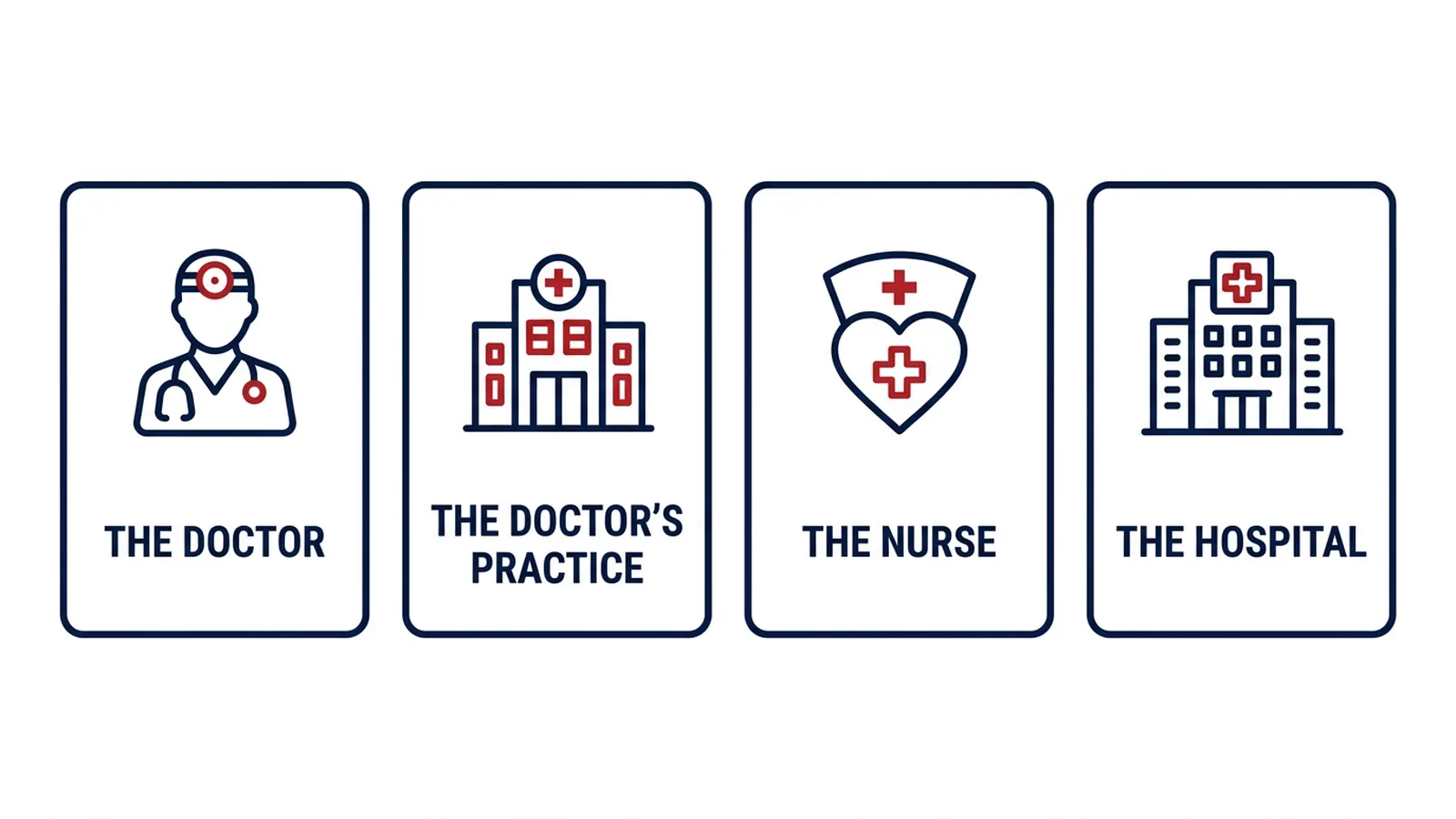
Put those pieces together for a birth injury case and this is the typical list. It starts with the doctor and the doctor's corporate practice, because many doctors are part of one. It moves to the hospital. It may add corporate entities within the hospital, and it may add the nurse. Each of those is a separate name on the complaint. I describe the work in these words: "it's a very complicated situation to make sure all the parties are correctly part of the lawsuit."
An employee's mistake belongs to the employer too
A second reason a facility belongs in a case comes from a rule most of us know from work. Those of you who have worked for a company will recognize it: when an employee makes a mistake, the employer is responsible.
Let's suppose a nurse's mistake is part of what went wrong in a hospital. The nurse is named as a defendant, and the facility is named as well. In my words, "an employee's actions go back to the employer." The nurse is responsible, and the facility is responsible too, because the facility answers for that nurse's actions. Both belong in the lawsuit.
The rule has a wrinkle, and I raised it earlier. Many doctors work for a separate corporation. The emergency room doctors in the example above are one case. So for a doctor, the question of who the employer is has to be answered by research, and that research is part of what a lawyer does before the complaint goes in.
Proper insurance and the search for the policies behind each name
Why go to all this trouble? Because we have to make sure that there is proper insurance. "Every one of these different entities may carry different policies of insurance." The job is to find the most insurance that we possibly can. If a birth injury case is successful, it can result in a monetary recovery, and we have to be able to find the insurance that will satisfy it.
That is where the hospital comes back in. In a birth injury case there can be several layers of insurance, and "we need to make sure that we have adequate insurance coverage to pursue a claim." Each entity may carry its own policy, so finding the names is how I find the policies.
Chapter 13 explains how coverage shapes a case. The point here is narrower: each name on the complaint is a possible source of coverage, and the research that produces the names comes before the filing.
A name left off the complaint, and the lawsuit within the lawsuit
This is what can happen when a name is missing. Let's suppose I bring a lawsuit against the doctor and no one else. The doctor says, wait a minute, I am not responsible, but even if I am, the hospital is responsible too. That hospital has not been made part of the lawsuit, because I have only sued the doctor.
The doctor's lawyers can bring a lawsuit to bring the hospital in. That is called a third-party defendant, and it is a lawsuit within the suit: the doctor saying that it is not my fault, but even if it is, somebody else is responsible too. Now remember who did what. I brought the lawsuit against the doctor. The doctor brought a lawsuit against the hospital. I have not connected those dots, and the doctor's lawsuit does not connect them for me. "I have to take some affirmative action." So I have to, what we call, amend my lawsuit. I change it and add in the hospital. Once I do that, everything is put together properly.
These litigation tools are meant for lawyers with a lot of experience, because they get very complicated. That is why a family needs an experienced medical malpractice lawyer for this part of a case.
To sum up the point for anyone on the plaintiff's side: with third-party defendants, you have to make sure you are bringing all the parties into your lawsuit, because if you don't, "you may be out of luck." Chapter 16 covers cross-claims, counterclaims and third-party defendants in full. The lesson for this chapter sits at the front end of a case. The names go on the complaint, and the research that finds them comes first.
Common Questions
- What does it mean to file a medical malpractice lawsuit in Maryland?
- It means a lawyer prepares a document called a complaint and brings it to the court. That used to happen on paper at the clerk's office, and now it is done online. Filing the complaint is how litigation starts, and it comes after the case has been worked up. Because the complaint names the defendants, the research into who was involved has to happen before it goes in.
- Can I sue just the doctor and the hospital in a Maryland malpractice case?
- Usually that is not enough. A doctor is usually part of a corporate practice, so the practice gets named along with the doctor. The hospital gets named, maybe corporate entities within it, and maybe a nurse. About Dr. Jones and the hospital, I say it plainly: "It's not as simple as that." The research comes first, to find the right entities.
- Who gets named in a birth injury lawsuit?
- A typical birth injury case starts with the doctor and the doctor's corporate practice. It moves to the hospital and maybe corporate entities within the hospital. If a nurse was involved, the nurse is named too, and the nurse may belong to a corporate entity that I have to discover. Which names belong depends on the research into who was involved and who they worked for.
- Can a hospital be sued for a nurse's mistake?
- Yes. The nurse is responsible, and the facility is also responsible. The way I put it, "the employer is responsible for the negligence of their employees." So in a lawsuit over a nurse's mistake, the nurse is named as a defendant and the facility is named as well. The facility answers for what its nurse did.
- What happens if a party is left out of a malpractice lawsuit?
- It can be serious for the plaintiff. If I sue only the doctor, the doctor's lawyers can bring the hospital in as a third-party defendant. That does not connect the hospital to my lawsuit, though. As the plaintiff's lawyer, I still have to take affirmative action, amend my complaint and add the hospital. Doing that work before filing is the safer course.
Chapter Reflection
A family sees a doctor, a nurse and a hospital. The record and the research around it show what stood behind them: a practice behind the doctor, a facility behind the nurse, and corporate entities that a patient had no way of knowing about. An employer answers for an employee, which is why the names come in pairs. Chapter 13 follows each of those names to the insurance behind it. For now the point is the order of the work: the research comes first, and the complaint comes after it.