
When a family calls me, there is a question underneath all the others, and it usually comes out as some version of this: was what happened to us a mistake? It is a fair question. The law answers it in a particular way, and the answer is not yes every time something goes badly in a hospital.
I tell everybody like it is. I use the term straight talk for that, and this chapter is straight talk about the line between a result nobody wanted and a medical malpractice case. A lot of people want to know where that line sits and what it means for the call they are about to make.
We will take it in order. First comes the yardstick the law uses, what we call the standard of care. Then the place of risk in every birth and every operation. Then the second question, whether any shortfall caused the injury. After that comes vocabulary, because malpractice, negligence, neglect and abuse get used as though they were different claims, and one of those words leads some people to decide they have no case. The chapter ends with a communication gap I see between patients and the healthcare system, and with how I try to set expectations from the first conversation.
the idea that you have a bad outcome or something bad happens to you doesn't necessarily mean there's medical malpractice.
A bad result is a fact about the outcome, not a finding about the care
The size of a harm tells you how much was lost. It does not tell you why. Everything else in this chapter rests on that, so let me put it as plainly as I can: a patient can be badly hurt, and the care that came before the hurt can still have been the care a doctor is expected to give.
Maryland's statute gives the injury its own definition. The law defines a "medical injury" as injury arising or resulting from the rendering or failure to render health care (Maryland Courts and Judicial Proceedings section 3-2A-01(g)). That is the wording of the statute, not mine. It tells you where an injury came from. Whether anyone was at fault is a separate question, and it is the one this chapter is about.
Let's suppose two people leave an operating room with the same kind of injury. In the first case the care followed the guidelines and the injury came from a risk of the operation. In the second the care fell below the guidelines and that failure caused the injury. The first is a bad outcome. The second is what we call medical malpractice. Nothing about the injury itself separates them. What separates them is what the care looked like and whether it caused the harm.
So I do not treat a result as an answer. The result is where I start asking, and the questions I ask come from the standard of care.
The standard of care in plain words
The term that we use is the standard of care. What that means is that there are "nationally recognized guidelines of what doctors should do and shouldn't do." Those guidelines are the yardstick. A lawyer like me measures the care against them, and not against how the result turned out.
The most important element of the case is the one I just named. As I put it, "The most important thing that we have to prove is we have to prove something called a violation of the standard of care." Those of us who do this for a living know what the phrase means, and it rolls off our tongues. A family has no reason to know it, which is why I define it before I use it.
How is it proved? Through other doctors. We have other doctors come into court who know what the standards of care are and who are able to tell the jury how those standards were violated or not adhered to. The work begins well before a courtroom. I consult with a practicing doctor who is familiar with the standards of care and the medical literature and who has lots of experience. That doctor's job is to say whether the doctor we are bringing a lawsuit against fell below the standards of care.
Then comes the part families find hard to hear. If we are unable to get a doctor to say that what the other doctor did was wrong, we can't move forward on a case. A family's belief that something went wrong deserves a hearing. It cannot stand in for a doctor who knows the guidelines and has reviewed what was done. Chapter 10 explains the signed certificate that Maryland generally requires from that doctor, and Chapter 2 builds the negligence case on the standard itself.
Risk comes with every birth and every operation
The other question that comes up right away is about risk. Here is how I answer it: "there are risks to every birth, there are risks to every surgery." A lot of people have surgery, whether that is elective surgery or emergency surgery, and a mother going into labor faces the risks of a birth. Risk is part of the care before anyone is hurt.
I have to be careful about what follows from that. Someone who has an injury from a risk has been hurt, and I will not shrink that. But just because someone has an injury from a risk doesn't necessarily mean that it is medical malpractice. Like I said, we have to go back to the standard of care.
Let's suppose a person has an operation, and one of the risks of that operation happens to them. The injury is real. Is it malpractice? Not by itself. The question I go back to is the same one I always go back to: did the care meet the standard? If it did, an injury from a risk does not become malpractice just because it hurt. If it did not, we are having a different conversation, and the next section is about what that conversation requires.
Falling short is half the case: the departure also has to cause the injury
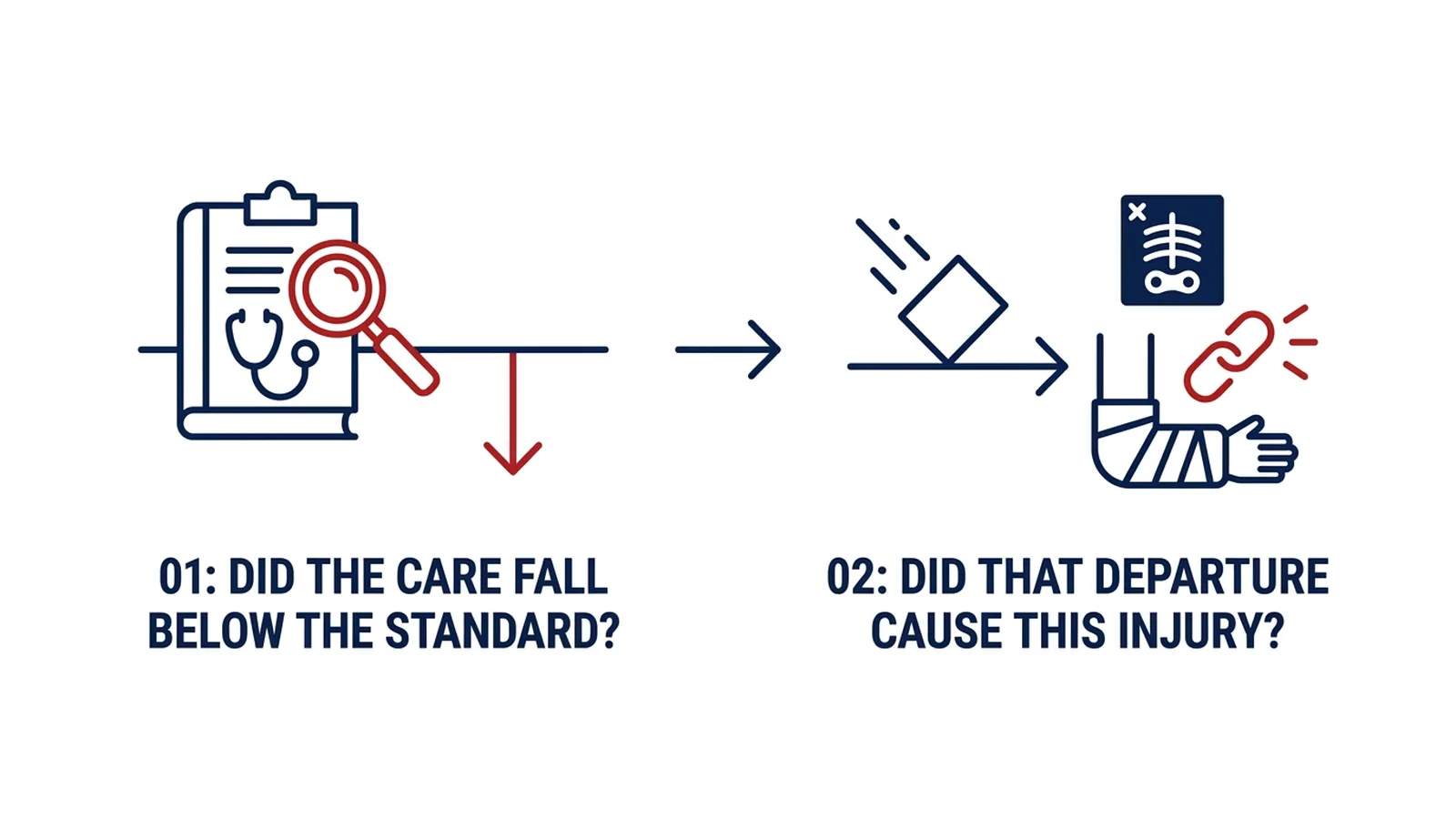
There are two questions in these cases. Did the care fall below the standard? And did that departure cause this injury? Like I said, the first is the standard of care. The second is a separate question. As I explain it, "we have to prove that that violation or breach of the standard of care caused the injury in question."
Both questions take work. In a birth injury case I go through the medical records with a fine tooth comb and build timelines of when things happened. Everything is charted: when a nurse comes in, when a nurse goes out, when a doctor comes in, when a doctor goes out. One of the records that helps is the baby monitor strip from labor, which can show when an injury occurs, whether that is because of a delay in delivery or sometime earlier. When the injury occurred matters to the second question. Chapter 8 and Chapter 9 take those records apart.
Then we consult with practicing obstetricians or other specialists who go through the records alongside us. Together we look at whether the standards of care were met, whether any violation caused injury, and how severe and how permanent the injuries are. It takes a lot of work on the front end. It takes months of investigation before we are able to tell someone that they have a case.
That does not mean every answer takes months. A caller who reaches me speaks to me directly, and I can often tell that person early on that I don't see a case. Confirming that a case exists is the slow work.
Malpractice, negligence, neglect and abuse describe one claim
A lot of people describe this subject with different names: medical negligence, medical malpractice, medical neglect, medical abuse. I keep using the term malpractice, and the others mean the same thing. As I say it, "A lot of people use all these terms to mean the same thing." A medical accident and a medical mistake belong on that list too.
I hear the confusion on the phone. Callers tell me they don't want to bring a medical malpractice case, but they do want to bring a medical negligence case. I explain that they are one and the same. I like to talk about a case by its ingredients, and I can tell you that "It's the same ingredients that go in to a case, no matter what you call it." That matters, because a person should know that the label does not change what has to be proved.
Malpractice is the word that causes trouble. Here is how I describe the problem: the word malpractice sometimes makes people think "my doctor did something on purpose or they did it with the intent to hurt me." Then they tell themselves they will never be able to prove that, and so they decide that they don't have a case. They believe malpractice means something different than negligence does.
It doesn't. Medical malpractice and medical negligence mean the same thing, and the most important element to prove is a violation of the standard of care. A person who decides on the strength of a single word that they have no case has been misled by that word. The facts come first, and the label does not change them.
The gap between what a patient expected and what happened
A lot of my clients are very upset to learn that the outcome they have after surgery isn't what they expected. I hear it around neurosurgery, where a lot of people get spinal fusions or neck fusions, which are very complicated operations that people get frequently, especially as they age. There are a lot of complications around those operations, and a lot of miscommunication too.
What I see is "a communication problem between the healthcare system and the patient." In my view, the patient has not been grounded in what to expect and in what the outcome should be. I am describing a gap in communication. I am not calling it malpractice. A gap between what a person expected and what happened is a good reason to start asking questions, and it is not an answer to them. The answer comes from the two questions in this chapter.
That is why expectations come up at the start of a case. After thirty-five years of this work, here is how I put it: "at the beginning, you have to make sure that the expectations are aligned." I tell everybody like it is. I explain what the process looks like, how long it will take, what the potential outcomes are and what the decision points will be. I tell my clients, "let's manage our expectations."
Let's suppose a family leaves a first conversation believing that a bad result and a winning case are the same thing. They could be set up for a harder disappointment later. So I say the other half out loud. Whether it is a medical malpractice case or a birth injury case, I think the common mistake is not managing expectations. I can't turn back the hands of time. I wish that I could. What I can do is give a family an honest account of what the law asks, and the first honest thing to say is that a bad outcome does not settle the matter either way.
Common Questions
- Does a bad medical outcome mean malpractice?
- No, not necessarily. A bad result tells you what happened to the patient, not whether the care met the standard of care. Medical care carries risk, and an injury from a risk is not automatically malpractice. Two questions decide it: did the care fall below the nationally recognized guidelines, and did that departure cause this injury? A bad outcome alone answers neither one.
- What is the standard of care in a medical malpractice case?
- It is the set of nationally recognized guidelines for what doctors should and shouldn't do. A case starts when a doctor's care fell below them. I prove that through other doctors who know the standards and can tell a jury how they were violated. As I put it, "If we are unable to get a doctor to say that what the other doctor did was wrong, well, we can't move forward on a case."
- Is medical negligence the same as medical malpractice?
- Yes. Malpractice, negligence, neglect and abuse are terms people use for the same thing, and the same ingredients go into the case whichever one you choose. Some callers tell me they want a negligence case but not a malpractice case. I explain that, as I put it, "they're all one and the same." What I have to prove first is a violation of the standard of care.
- Does malpractice mean the doctor meant to hurt me?
- No. The word can make people think a doctor acted on purpose, and that thought leads some of them to decide they cannot prove it and have no case. But malpractice and negligence mean the same thing, and the most important element I have to prove is a violation of the standard of care. A person should not give up on a claim because of what a word sounds like.
- Why are patients surprised when surgery does not turn out as they expected?
- To me it is a communication problem between the healthcare system and the patient. A lot of my clients are upset to learn the outcome after surgery isn't what they expected, and I see it with complicated operations like spinal and neck fusions. The patient was not grounded in what to expect. That gap is a reason to ask questions, and it is not an answer.
Chapter Reflection
A result can be terrible and the care can still have met the guidelines. The care can also fall short and still not be what caused the harm. Both are true, and that is why the outcome alone never settles whether a family has a claim. The family needs two answers, one about the standard and one about cause, and neither is visible from the result alone. Chapter 2 starts with the first answer, the guidelines themselves, and shows how a negligence case is built on them.