
Cross-Claims, Counterclaims, and Third-Party Defendants Explained
A lot of people want to know what it even means to say a case has been "filed in court." The answer is shorter than they expect, and it opens the door to the part of a malpractice case where the vocabulary turns strange. Once the complaint is filed, the case is in litigation, and litigation is a battle. The lawyers on each side do the best they can for their clients, and the tools they reach for have names that mean little to anyone outside a courtroom: cross-claims, counterclaims, third-party defendants.
This chapter explains each one the way I would explain it to a family sitting across the desk from me. A cross-claim is what we call a lawsuit within the suit, brought by one defendant against another. A counterclaim runs the other way, from a defendant back at the patient. A third-party defendant is someone a defendant pulls into the case who was not named at the start. Of the three, the cross-claim is the one I like to see, because the defendants are then pointing at each other. A counterclaim almost never happens, and the third-party claim is a reminder to bring every party into the case.
I will also be plain about what these tools do not do. Finger-pointing between a doctor and a hospital can help a family's case, and it does not decide it. Chapter 12 covered who gets named in a Maryland malpractice lawsuit, and this chapter picks up after the names are on the page. Chapter 17 follows one case where a doctor and a nurse blamed each other.
Now actually from a plaintiff's point of view, me as the plaintiff's lawyer, I actually like when that happens because now they're going to start pointing the fingers at each other. That makes my job a lot easier.
What filing a complaint sets in motion
By the time a case reaches the courthouse, the work behind it has been done: the medical records reviewed, the timelines built, the doctors consulted. Filing is the next step. The plaintiff's lawyer prepares a document called a complaint and brings it to the court. It used to be that you carried the paper to the clerk's office. Now we do everything online. Once the case is filed, that is how litigation starts.
The person who brings a lawsuit is called the plaintiff, and the person being sued is called the defendant. I try not to use too many legal terms, but sometimes I slip, so I want that definition out of the way. In this chapter the family is the plaintiff, and everyone named in the complaint is a defendant.
The corporate world makes the picture more complicated than it looks. It is not as simple as suing Dr. Jones and the hospital. Why is that? Well, first of all, a doctor is usually part of a corporate practice, operating under something like Babies Inc. or Babies LLC. That practice could be one doctor or a large group. A nurse may belong to a corporate entity that I have to discover. So I bring the lawsuit against the doctor and the doctor's corporate entity, against the nurse where a nurse is involved, and against the hospital and the hospital's corporate entity. The plaintiff's lawyer has to do that due diligence, because the lawsuit is only as complete as the list of parties in it.
The reason it matters is insurance. Each of those entities may carry a different policy, and I need to find the most insurance I possibly can, because a successful birth injury case can result in a large monetary recovery and the coverage has to be there to meet it. Chapter 13 takes up insurance on its own.
Once everyone is in the case, the defendants have their own lawyers, and their lawyers do not necessarily see the case the same way. That is where the new vocabulary begins.
A lawsuit inside the lawsuit: how a cross-claim works
Let's suppose I bring a lawsuit against a doctor, the doctor's practice and the hospital in a birth injury case. The allegation is that the doctor and the nurse did not deliver the baby early enough, and that the baby was deprived of oxygen. Doctors do get to go home and take call, which means they are at home, and if there is a problem with one of their patients the nurse is supposed to call. So in a case like this, the doctor is usually either not in the room or at home, and the nurse is the one coming in again and again to check on the patient.
Let's suppose the nurse calls the doctor and says she is looking at the baby strips, the machine that shows how the baby is doing, and things do not look so good. Let's suppose the nurse says, "Doctor, I think there's something wrong here," and the doctor answers, "Tell me the information over the phone." The doctor decides everything is okay. Let's suppose there are several calls like that. Then, God forbid, the worst happens and the baby is permanently injured.
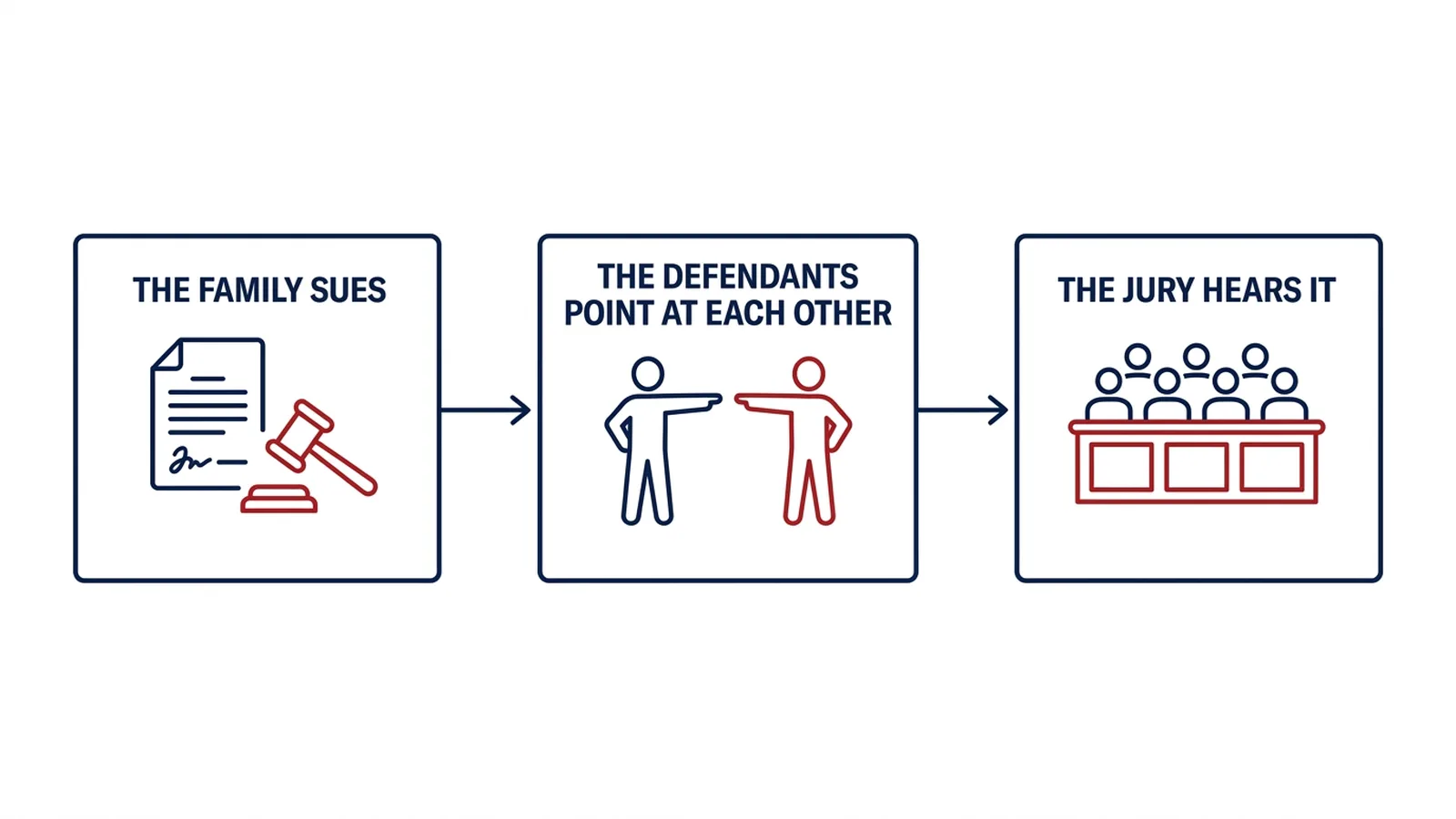
When the lawsuit is brought, there is going to be finger-pointing, and it sounds like this. The doctor says the nurse did not give all of that information in a way that raised any concern, and did not explain it properly. The nurse says she told the doctor everything, and she told the doctor she thought there was a problem. Now you have a finger-pointing situation.
How does that show up in a piece of litigation? Well, that is what we call a cross-claim. The doctor and the hospital are represented by two different lawyers. The doctor's side wants to say that the nurse gave the wrong information, so the fault belongs to the nurse and the hospital. A defendant can only say that in the lawsuit by filing a cross-claim, which is a court document, what we call a pleading. In it, the doctor brings a lawsuit within the suit, against the hospital, over what the nurse said. If the jury returns a verdict against the doctor, the doctor is asking to shift that responsibility onto the nurse.
A plaintiff's lawyer has reason to welcome that. Once defendants start pointing at each other, I can bring that out in front of the jury, and they are fighting among themselves. In my words, "That makes my job a lot easier."
Now I have to be honest about how often it happens. Cross-claims are very rare. Many times the doctor, the nurse and the hospital stand together. In my words, "Many times the doctor and the nurse and the hospital will stand as a united front." They do not file cross-claims against each other.
There is one situation where defendants do sometimes file a cross-claim, and it is a technical one. It has to do with what happens if there is a money judgment: who is responsible for it, and what portion or percentage each defendant is going to contribute. That is beyond the scope of this book. It has nothing to do with the underlying case, because it concerns something that happens afterward.
Counterclaims, and what a jury would think of a doctor suing a patient
The second tool runs in the opposite direction. A counterclaim is what we call a claim a defendant brings back against the plaintiff, meaning the patient, and not against the lawyer. Let's suppose I bring a lawsuit as the plaintiff's lawyer against a doctor, and the doctor believes the patient did something wrong. The doctor can answer with a counterclaim. In effect it says: I did not do anything wrong, and not only that, you are the one who did something wrong.
In medical malpractice and birth injury cases, counterclaims rarely, if ever, happen. I have been doing this work for thirty-five years, and "I can't think of the last time, if any time, a counterclaim was filed in any of my medical malpractice cases or birth injury cases."
Why is that? Well, think about it as a matter of tactics. A doctor who brings a lawsuit against his or her own patient has to ask how the jury will react. Jurors, to my mind, are not going to like it at all. They are going to think the doctor is taking advantage of somebody, blaming somebody, and refusing to take accountability. A hospital does not want to be seen picking on a person who has been horribly injured, and that is especially true in a birth injury case. So even a defendant who believes there is some counterclaim to bring does not often bring it.
Holding back a counterclaim does not mean a defendant gives up the argument. Another place exists to make it.
Contributory negligence belongs in the defense, not in a counterclaim
A defendant can raise defenses to protect itself without filing a counterclaim, and the clearest example in Maryland is contributory negligence. Maryland is one of a small handful of states that still has this rule. In practice, it works like this. If you are the plaintiff and you bring a lawsuit, and you prove the doctor was negligent, the jury can still find that you contributed to the negligence yourself. "Even if you prove that the doctor was negligent, if the jury finds that you contributed to the negligence yourself, even a little bit, and we call it 1%, you can lose the entire case."
Let me show how the defense would put it. The doctor says you were contributorily negligent, meaning you were also negligent, because you did not show up to your appointments, or you did not follow the test the doctor asked you to get, or you did not take the vitamins or medicines the doctor told you to take. Therefore, the doctor says, it is your fault. The distinction fits in one line: "You wouldn't bring that in a counterclaim, but you can bring that as a defense." The accusation is the same. The vehicle is different.
Now, a patient who delayed care or missed an appointment may well wonder about that rule. So let me give the practical side. In theory, your case could be over if you delayed care. But the defense in a medical malpractice case does not want the jury to think it is blaming you for something that should have been its own responsibility. Because of that, the idea of the defense blaming the patient is probably not going to happen. The answer I give families is practical: "The practical answer really is it doesn't come up that often in medical malpractice cases."
Bringing the hospital in: third-party defendants and the amended complaint
The last tool is a little bit complicated. It is called a third-party defendant. What does that mean? Let's suppose I bring a lawsuit against the doctor, and only the doctor. The doctor says, wait a minute, hold on. Responsibility is not mine, but even if I am responsible, the hospital is responsible too. The hospital has not been made part of the lawsuit, because I have sued only the doctor.
The doctor's lawyers can then bring a lawsuit to pull in the hospital, and that is what we call a third-party claim, with the hospital as the third-party defendant. Once again it is a lawsuit within a lawsuit. It says: it is not my fault, but even if it is my fault, somebody else is responsible too.
I hope I am not making this too complicated, so let me go slowly, because this is the part where a family's lawyer has work to do. I brought my lawsuit against the doctor. Now the doctor has brought a separate lawsuit against the hospital. But I have not connected those dots. I have not sued the hospital, and the doctor suing the hospital does not mean that I, as the plaintiff, have done so. "I have to take some affirmative action, so I actually have to, what we call, amend my lawsuit." That means I change my complaint and add the hospital. Once I do that, everything is put together properly.
The stakes are plain. If you represent the plaintiff, you have to bring all the parties into your lawsuit, because "if you don't, you may be out of luck." That is why I did all that due diligence on the corporate entities at the start, and why Chapter 12 matters as much as this one.
Litigation tools like these are meant for lawyers who have a lot of experience, because it gets very complicated. As noted at the start of this chapter, the parties in litigation are each trying to win. We may have had settlement negotiations, and maybe some friendly conversations. Now all bets are off. When a case goes into litigation, there are many tools at the disposal of the plaintiffs, and the defendants have them too.
What finger-pointing does and does not tell a family
The common mistake about all of this is easy to make. A family hears that the doctor and the hospital are blaming each other, and the natural conclusion is that a jury will certainly vote for the plaintiff and there is nothing to worry about. That is a common mistake, because that is not how it works. Even with finger-pointing, we have to present the evidence and we have to tell the story. And "even in cases of finger pointing, jurors have come back and voted for the doctor and the hospital." They did not find in favor of the plaintiff.
So I tell all my clients, "Let's manage our expectations." Finger-pointing does not mean we are going to win, and it does not mean we are going to get a large settlement. Sometimes the doctors, the hospitals and the insurance companies are adamant, and they want to go forward.
Finger-pointing still has value, and I have seen it work in the right case. In one birth injury case I was involved in, a doctor's insistence on blaming a nurse put the family in a stronger position in settlement talks, and Chapter 17 tells that case.
Common Questions
- What is a cross-claim in a medical malpractice lawsuit?
- A cross-claim is a lawsuit within the suit, filed by one defendant against another defendant in the same case. Let's suppose a doctor says a nurse passed along bad information. The doctor's lawyer files a court document called a pleading, asking that responsibility shift to the nurse and the hospital if the jury finds against the doctor. In my work, cross-claims are very rare, because defendants often present a united front.
- Can a doctor countersue a patient in a malpractice case?
- A doctor can file what we call a counterclaim against the patient, but in medical malpractice and birth injury cases it rarely, if ever, happens. The reason is tactics. A jury is unlikely to react well to a doctor suing an injured patient, and, in my words, "They're not going to want to look like the big bad guy." A defendant can still raise the patient's own conduct, but as a defense instead.
- What is a third-party defendant, and why would a lawyer amend a lawsuit?
- A third-party defendant is someone a defendant pulls into the case who was not named by the plaintiff. Let's suppose I sue only the doctor, and the doctor's lawyers bring the hospital in. That does not make the hospital a defendant in my lawsuit. I have to amend my complaint, which is what we call changing it, and add the hospital, so everything is connected properly.
- Can missing appointments end a Maryland malpractice case?
- In theory, yes. Maryland is one of a small handful of states with contributory negligence, which means a jury that finds the patient even a little at fault can end the case. In practice, the defense does not want the jury to think it is blaming the patient for something that was its own responsibility, so it probably does not happen often.
- Does finger-pointing between defendants mean the family will win?
- No. Finger-pointing can help, and it does not decide the case. Even with defendants blaming each other, the plaintiff still has to present the evidence and tell the story, and jurors have voted for the doctor and the hospital in cases like that. I tell my clients that we have to manage our expectations. Sometimes the doctors, hospitals and insurance companies are adamant and want to go forward.
Chapter Reflection
Finger-pointing between defendants is welcome when it arrives, and no family should plan around receiving it. Cross-claims are rare, defendants often stand together, and a counterclaim rarely, if ever, appears. Contributory negligence is the rule in the chapter that can end a case over a patient's own fault, and, in my experience, it does not come up that often in malpractice cases. A third-party claim can leave a family out of luck if the lawyer does not amend the complaint and bring the new party in. None of these tools carries a case by itself. The evidence still has to be presented, the story still has to be told, and the right parties still have to be in the lawsuit before any of it can count. Chapter 17 puts a doctor and a nurse in exactly that position, pointing at each other, and shows what that looked like in one case.