
The Medical Mistakes That Reach a Baltimore Malpractice Lawyer Most: Surgery, Anesthesia, and Missed Diagnoses
When families first call me, a lot of them are carrying one picture in their heads: something going wrong on an operating table. That picture covers part of what I see, but only part. A medical malpractice lawyer like me runs the gamut, and the calls range from an operation that did not go as planned and an anesthesia error to a doctor who told someone a suspicious lump was nothing, only for months to go by.
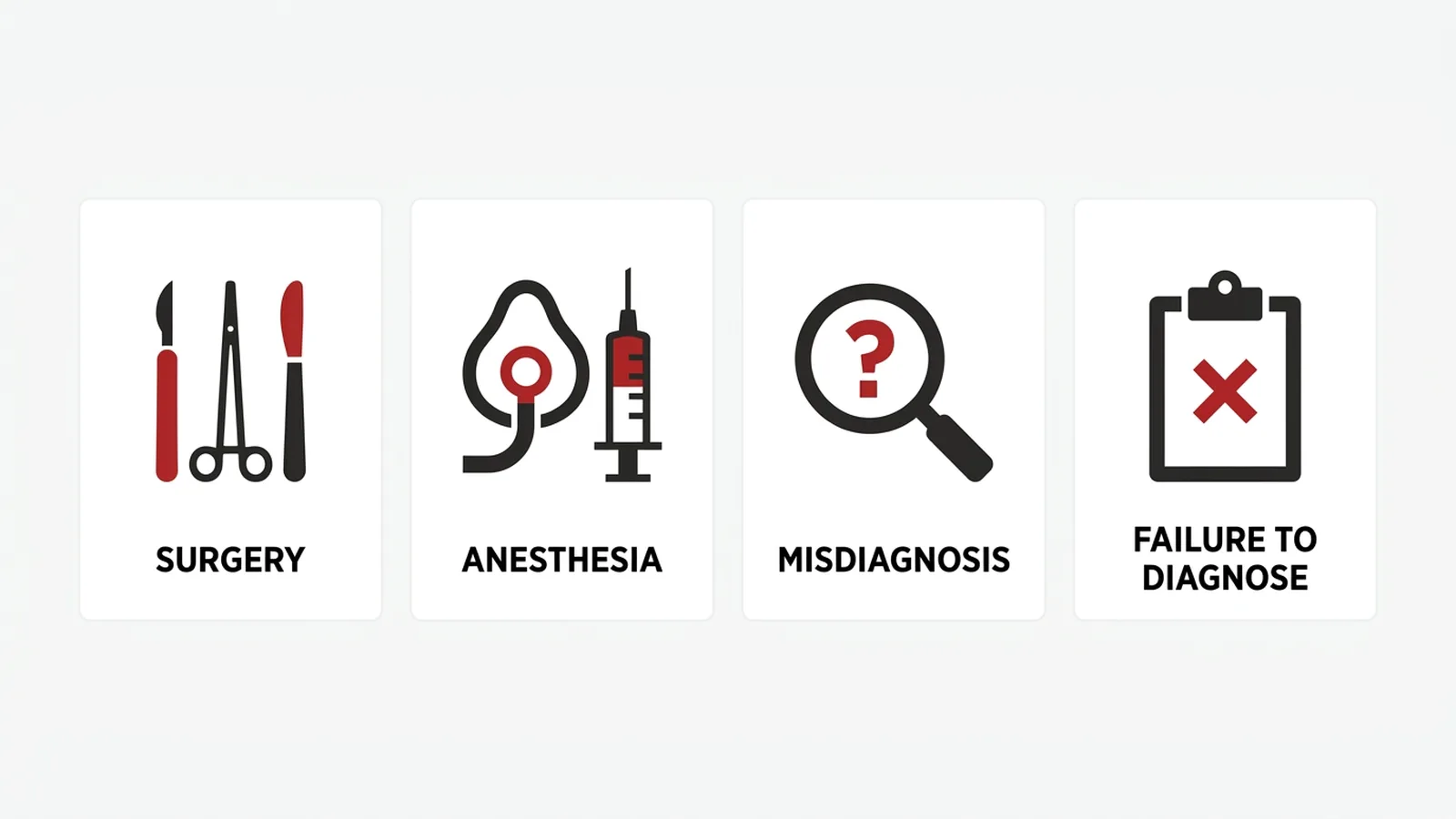
This chapter takes those situations one group at a time. It starts with surgical complications and the kind of error we call wrong side surgery. It moves to anesthesia, then to misdiagnosis and what we call failure to diagnose. It also covers neck and spine fusions, which are complicated operations that more people undergo as they age, and a question that sits underneath many of the calls I take: if the mistake looks obvious, does the case become easy? It does not, and I will explain why.
One caution before the list. Everything I say here about what comes up most comes from my own calls, the ones that reach a Baltimore lawyer, and not from a statewide count of anything. A caller who has had a bad experience in one of these categories does not automatically have a case. Chapter 1 draws the line between a bad outcome and malpractice, and Chapter 2 explains how a negligence case is built. Here I want to show you what these situations look like when a family describes them.
So I would say surgical mistakes by far are the biggest volume of calls that I get.
The kinds of calls a Baltimore malpractice lawyer hears
Start with a plain fact about modern medicine. "A lot of people have surgery, whether that's elective surgery or emergency surgery." Some operations are planned well ahead, and some happen in a hurry. Either way, an operation is a place where a lot can go wrong, and that is where many of my calls begin.
When I look for the reason, I come back to how often these operations happen. The ones I hear about are hip replacements, knee replacements, gallbladder operations and heart surgeries. Those are everyday procedures, and my reasoning is that with that level of frequency you can expect a matching level of surgical mistakes. I offer that as my own reasoning about my own calls, not as a measurement.
Surgery is not the only place families call from. Like I said, a lawyer like me runs the gamut. Misdiagnosis is another big area, failure to diagnose is a close relative of it, and I see a lot of cases involving neurosurgery. Each has its own section below.
Many of the people on the other end of those calls are angry and confused. Some of them had a good relationship with their doctor right up to the surgery, then something bad happened, and they did not see the doctor again. They want to get it off their chest, so I let them tell their story. When a call does not turn into a case, the reason is one of two. "Either we tell the potential client that there is no malpractice here. We don't think the doctors did anything wrong." Or the injury is not enough to substantiate a case, because a person who was hurt and then got well does not have much of a case to bring, given how expensive a case is to bring. Chapter 6 takes up that part in full.
Surgical complications and wrong-side surgery
The group I hear about most often starts with what I call a surgical complication. Sometimes that means a surgery that gets called "botched, which means the surgery didn't go as planned." By itself that word does not tell a lawyer whether anyone did anything wrong. That question belongs to the standard of care, which Chapter 2 describes.
Then there is what we call wrong side surgery. I will give you the example I give, because it is easy to picture and the facts are plain. "There was supposed to be an operation on the left knee, and the nurse put a mark on the wrong knee and no one checked it." Walk through it one beat at a time. The operation was meant for the left knee. A nurse put a mark on a knee, and the mark went on the wrong one. No one checked it. The patient was then operated on in the other knee, the one that was not supposed to be operated on. That is wrong side surgery.
I describe it as something that comes up a lot. In my words, "Sometimes there's a situation called wrong side surgery that happens a lot."
Two facts carry that example: the wrong mark and the missing check. Later in this chapter I will explain why even a mistake this plain still has to pass through the same safeguards as any other case.
Anesthesia errors and serious injury
Surgery brings a second group of calls with it. In my words, "with surgery, there's also complications with anesthesia." And I do not soften what I have seen: "Unfortunately I've had serious cases where people have been very seriously injured because of anesthesia error."
I will not describe the medicine behind an anesthesia error here, because I want to stay with what I can say from my own work. What I can say is where it sits. It belongs with the surgical group, because the injury comes with an operation, and it is part of why surgery fills so much of my calls. An anesthesia injury is measured the way any other claim is measured, against the standard of care in Chapter 2, and the certificate that Chapter 10 describes generally applies.
When someone has been seriously hurt this way, I cannot turn back the hands of time. I wish that I could. What I found over my career is that I can provide at least some measure of comfort to people whose lives have been turned upside down, and that I can make sure we hold the system accountable. "People really want accountability." They understand that mistakes happen. That does not mean they are willing to let one go.
Misdiagnosis and failure to diagnose, side by side
Misdiagnosis is the second big area I hear about. A person goes in to see a doctor, complaining of something. The doctor says, well, it's nothing, don't worry about it. Then, in the words I use for it, "months and months go by, and all of a sudden it is something really major and really bad." In my own calls I find that a lot in cancer, where the first complaint was something suspicious on the skin or a suspicious lump.
Failure to diagnose is a close relative. A person goes in with symptoms, and "the doctor thinks it's one thing and doesn't really have an open mind when it actually was something else." The patient had a proper disease or a proper condition, and it went undiagnosed. I see that quite a bit. Put the two side by side and both are cases where something was missed.
I have to be careful here, because I would be misleading you if I stopped at the cancer examples. "Not every case is medical malpractice. Not every misdiagnosis is always medical malpractice." Some doctors face a hard call, and I put it plainly: "sometimes in a misdiagnosis situation, we can't prove that what the doctor did was wrong." A missed diagnosis may feel like proof to a family, and in my practice it is where the questions start, not where they end. Chapter 2 explains the difference between a judgment call and a departure from the standard of care, with an example from radiology.
Neck and spine fusions, and the gap between outcome and expectation
We have a lot of cases involving neurosurgery. A lot of people are getting spinal fusions or neck fusions. These are very complicated operations, and people get them frequently, especially as they age. In my experience there are a lot of complications around them, and there is a lot of miscommunication about them too.
What I see most clearly is this. "A lot of my clients are very upset to learn that the outcome that they have after surgery isn't what they expected." What I am seeing is "a communication problem between the healthcare system and the patient, in really grounding the patient into what the expectations are, what the outcomes should be."
Let me be just as clear about what it does not mean. A result that differs from what a patient expected is not malpractice by that fact alone. In my words, "most of the time, things that happen to people, bad outcomes are not medical malpractice at all." So when a caller tells me about a fusion that left them in a different place than they had been promised, I tell them where I come down. I tell everybody like it is. I use the term straight talk. In my work, the strategy for any case begins with making sure the expectations are aligned. I also put it this way: "we are telling most people why the healthcare system did the right thing by them and why they don't have a case." Sometimes they are disappointed to hear it, and I would rather say it plainly than leave a caller guessing.
An obvious mistake still passes through the same safeguards
Go back to the wrong knee. Here is the question I hear underneath that story. "A lot of people think, well, just because my doctor operated on the wrong side, that's automatic. I don't have to go through any of these procedures. It's going to be an easy case." My answer is short. "But that's not the way that it works."
It does work this way. Even for a wrong knee, "even though it sounds obvious, you still have to go through the safeguards of getting another doctor to review the medical records." That doctor must be willing to sign a certificate of qualified expert and to come into court and say that this was medical malpractice. Chapter 10 covers the certificate in full. That reviewing doctor must also be a practicing doctor. "They have to be practicing. They can't devote their whole lives to testifying in cases."
The law behind this is written down, and it is the law, not my words. Under Maryland Courts and Judicial Proceedings section 3-2A-04, unless the sole issue in the claim is lack of informed consent, a claim is dismissed, without prejudice, if the claimant fails to file a certificate of a qualified expert within 90 days from the date of the complaint. The certificate must attest to a departure from the standards of care and that the departure is the proximate cause of the alleged injury, which is the legal way of saying it caused the injury. The attorney files it with a report of the attesting expert attached. The statute also allows limited extensions of that deadline, and it limits an attesting expert to no more than 25 percent of the expert's professional activities devoted to testimony in personal injury claims during the 12 months before the claim was first filed.
What, then, does an obvious error buy? Not a shortcut. What it allows us to do is state an obvious error, and "that has a lot of jury appeal." When someone has surgery on the wrong knee, I expect the case would probably settle, because it is so open and obvious. But to get to that point, we still follow all of the laws and procedures that apply to any malpractice or negligence case.
A practical safeguard sits beside those rules, and it has nothing to do with court rules. Lawyers like me take cases on what we call contingency, which means we don't get paid unless we win. A malpractice case is enormously expensive to bring, and if we lose, we lose what we put in. A lawyer who builds flimsy cases is not going to be in business long.
Common Questions
- What kind of medical malpractice case gets the most calls from Baltimore families?
- For my practice, it is surgery. I can only speak to the calls that reach me, and I have no statewide count to offer. By far the most frequent type of case that reaches me has to do with a surgical complication, and I say that only about my own calls. Misdiagnosis, failure to diagnose and neurosurgery are other big areas, and anesthesia errors sit alongside the surgical group.
- What is wrong-side surgery?
- It is what we call an operation performed on the wrong side of the body. My example is a left knee scheduled for surgery, where a nurse marked the wrong knee and no one checked it, so the patient was operated on in the other knee. Even a case that plain has to be built the usual way, which Chapters 2 and 10 describe.
- What is the difference between misdiagnosis and failure to diagnose?
- They are close relatives. In a misdiagnosis, a patient raises a concern, such as something suspicious on the skin or a lump, and the doctor says it is nothing. Failure to diagnose, which I call "a sort of a first cousin to that," is when a patient comes in with symptoms and the doctor settles on one explanation without an open mind. Either can be malpractice, but not every one is.
- If a doctor operated on the wrong side, is the case automatic?
- No. A lot of people expect a wrong-side error to be an easy case, and it does not work that way. The same safeguards apply: another doctor reviews the records, a certificate of qualified expert is signed, and that doctor is willing to testify in court. What an obvious error does give us is jury appeal, and I expect a case like that would probably settle.
- Is a disappointing result after spinal or neck surgery medical malpractice?
- Not by that fact alone. A lot of my clients are upset to learn the outcome is not what they expected, and I see a communication problem between the healthcare system and the patient about what to expect. The measure I use is the standard of care, which Chapter 1 explains, and a result that differs from expectations does not by itself show a departure from it.
Chapter Reflection
A family on the phone gives me a story, and the story usually arrives with a name attached: a botched surgery, a wrong knee, a doctor who said it was nothing. The name is where the call begins, and it is not where the case begins. The case begins with what the doctor did, measured against the standard of care, and it moves forward when another doctor is willing to put a signature to the claim and say so in court. That holds for a knee marked wrong and for an outcome after a fusion that a patient did not expect. I cannot turn back the hands of time, and I wish that I could. What I can do is explain how it works and tell a family the truth when the answer is no. Birth injury, which not a lot of lawyers handle, puts the same questions to a very different set of records, and Chapter 5 begins with what a family can do first.