
Every chapter before this one has been about what it takes to prove a case: the standard of care, the medical records, the doctor who signs the certificate. This chapter is about a rule that can end a case before anyone gets the chance to prove a thing. It has nothing to do with medicine. It has to do with a date, and a family that misses the date loses the case no matter what the records show.
I will give you the rule the way I give it to the families who call me, and then I will show you where it comes from. Along the way I will explain why one phrase in the Maryland rule, "knew or should have known," makes lawyers who handle these cases reach for a simpler count. I will set out what the Maryland statute says, labeled as the law and not as my opinion. And I will explain why a child's deadline is a different question from an adult's, one a family should never settle alone.
Before you hold on to any number in this chapter, hold on to the idea of a deadline. The numbers depend on facts: when the injury was committed, who was hurt, how old that person was at the time. I cannot see those facts from the page. A lawyer who has your records can.
Because if you call me when it's too late, there's nothing I can do to help you.
A strong case filed one day late is a lost case
A lot of people picture a lawsuit as a fight over what happened in the operating room or the delivery room. Before that fight can begin, there is a rule about when it is allowed to begin, and it is the rule I most want every family to know.
Let's suppose you have the greatest case in the world, with the best doctor behind it. Let's suppose you file your lawsuit on the first day after the third year in Maryland. Nothing about the medicine has changed overnight, and none of it matters. In my words, "You could have the greatest case in the world, but it's going to be thrown out. It's over because you didn't file it on time."
A lot of people also ask what "filed" even means. It means that a lawyer prepares a document called a complaint and brings it to the court. It used to mean carrying paper to the clerk's office. Now it is all done online. Once the case is filed, that is how the litigation starts, and the date of that filing is what the deadline measures.
We are bound by rules, and "rules tell us certain deadlines when things have to be submitted into court." The lawsuit has a deadline. The certificate of qualified expert has a deadline of its own, since it is filed with the lawsuit or within the window the statute allows (Courts and Judicial Proceedings section 3-2A-04(b)), and Chapter 10 covered that clock. This chapter is about the larger one, the time a family has to bring the lawsuit at all. Both are the reason I say, "So you must have an experienced medical malpractice lawyer who knows the rules and will file things on time."
The count I give adults: three years from the injury
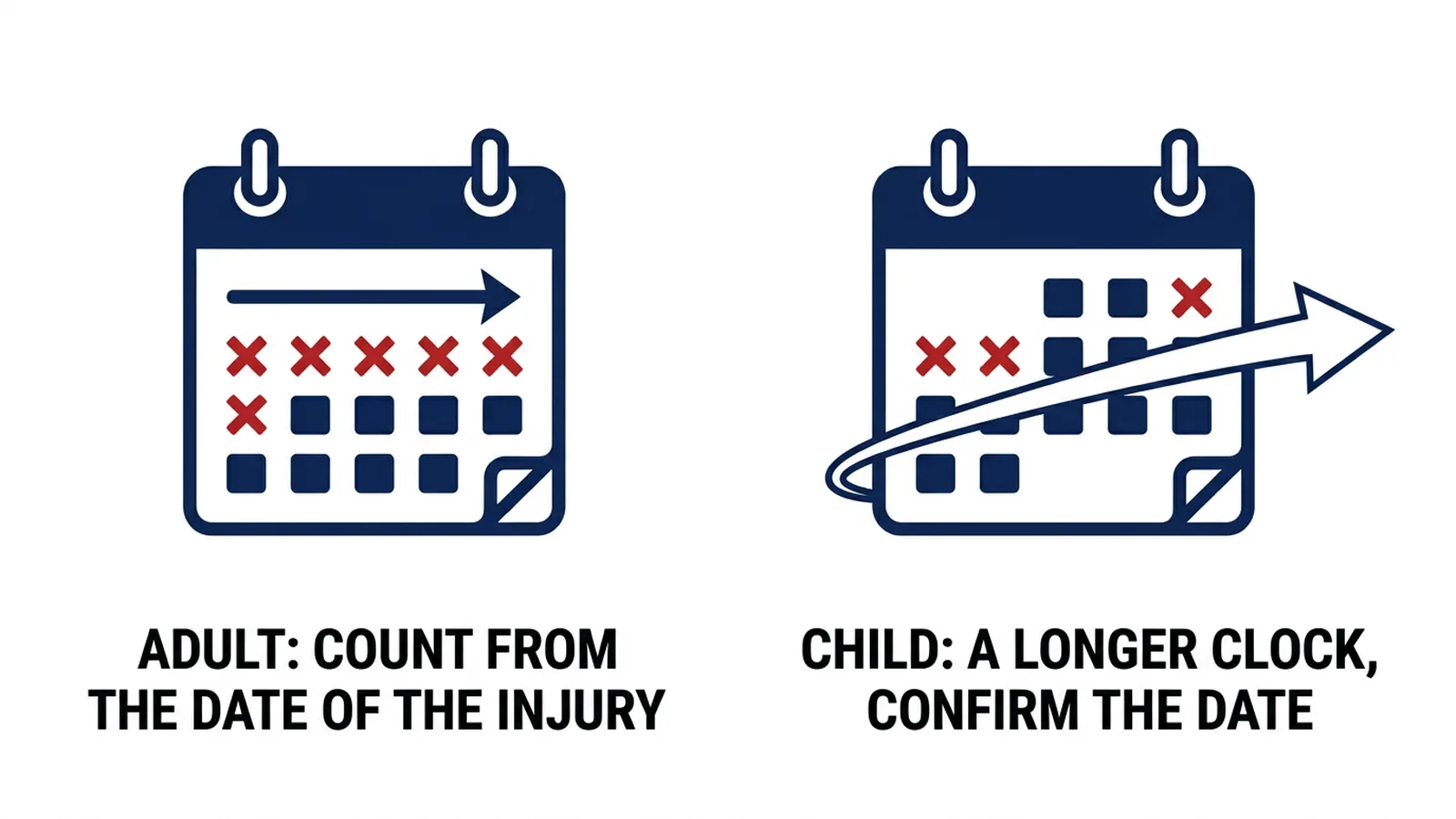
The general rule, the way I state it: in Maryland, an adult has three years from the date the malpractice happened to bring a lawsuit. That is the number most callers need, because most of the people who call me are adults.
The rules around that number get more complicated, and I will come to them. When they do, I fall back on a count that is easy to explain and hard to get wrong. "So the rule that I use is three years from the date that the malpractice was committed upon you." It is also the conservative way to count. In my words, "That's the most conservative and that is the time that we tell our clients."
The consequence of missing it is spelled out in the plainest terms I know. "You must bring a lawsuit within three years, or else you can't bring it again." There is no second try.
I will say it the simple way once more, because simple is where a family should begin: "You have three years in Maryland to bring a lawsuit. That is the most simplified way to express it." Notice the last words. I call it the most simplified way, which tells you there is more underneath it. A simple rule is a place to start counting. It is not a substitute for someone looking at your dates.
Knew or should have known: where the clock becomes a guess
Underneath the simple rule sits what we call discovery. As I describe it, Maryland law gives a person three years from the date that person knew or should have known that medical malpractice was committed upon them. It sounds fair. Then you try to use it.
Let's suppose a family learns long after the care that something went wrong. When did they know? And the harder question: when should they have known? The first asks what was in their minds. The second asks about a person who was not told, and there is no calendar date that answers it. The difficulty is real. "That's very confusing. It's very confusing for those of you watching, and it's very confusing for lawyers who do this." The question sits at the center of the whole rule: when does that clock start running?
I wish the law were clearer, and I have said so: "Maryland law is very confusing, and I wish they would change it." Until it does, I do what lawyers who handle these cases do. We use a much more defined time, three years from the date of the injury, and we give that date to clients instead of leaving them to guess at what they should have known.
What section 5-109 says about the earlier of two dates
This part is the statute speaking, not me. I cite each piece so that a family can read it for themselves.
Maryland Courts and Judicial Proceedings section 5-109(a) says that an action for damages for an injury arising out of the rendering of, or failure to render, professional services by a health care provider shall be filed within the earlier of two periods: five years of the time the injury was committed, or three years of the date the injury was discovered. The word in the statute is "discovered." The phrase "knew or should have known" is how I describe that discovery part.
Now let me put dates into it. What follows is arithmetic on the statute's words, not another statement from the statute. Let's suppose the injury is discovered the day it is committed. Both periods begin together, and the three-year period ends first. Now let's suppose the injury is discovered later. The three years from discovery start later, but the five years from the injury have been running since the injury itself. Because the statute says "the earlier of," the period that ends first is the one that counts.
Count three years from the date of the injury and you land on or before the end of either period. That is why I call my count conservative, and it is why I give it to clients.
The statute adds one more place to the picture. Section 5-109(d) says that filing a claim with the Health Care Alternative Dispute Resolution Office in accordance with section 3-2A-04 is deemed the filing of an action for this purpose. Section 3-2A-04(a)(1)(i) provides that a person having a claim against a health care provider for damage due to a medical injury shall file the claim with the Director of that office. I describe filing as a complaint brought to a court. The statute names this office as well, which is one more reason the person doing the filing needs to know the rules.
Nothing in the statute hands a family a date. A lawyer's job is to put real dates into it.
A child's clock runs longer, and a lawyer still confirms the date
Three years is the rule for an adult. Maryland treats children differently, and the difference is large. In my view Maryland has a very generous time limit for children, and I tell people that this is not true everywhere: "Many states have very restrictive time limits." A child in Maryland gets far more time than an adult.
That matters most in birth injury cases, because the person who was hurt is a child.
The statute is where the rules for children live, and they live in more than one place. Section 5-109(b) provides that for a claimant who was young enough at the time the injury was committed, the periods in subsection (a) begin later than the injury, and subsection (c) sets a different later starting point for a few specific kinds of injury. The date for a given child comes from reading those provisions against the child's age when the injury was committed.
For that reason I will not put a single age in this book and ask you to plan around it. The statute's text for a child is more complicated than for an adult, and a lawyer has to confirm the date for the particular child, so I do not hand one over. If your child was hurt at birth, take the question to a lawyer now, and let that lawyer confirm the date for your child. A longer clock is still a clock.
Making podcasts and videos so the deadline is not a surprise
If you get nothing else out of this chapter, take one idea: "You don't have forever to bring a lawsuit." That is the whole point of a statute of limitations, which is a time limit set by law.
Many people have never been told that. "Most people do not know what the legal options are." Some do not know the time limit exists. Others have a misunderstanding of it, because they "look it up on the internet and the information that you get is not always accurate." Given how confusing the rule is even to lawyers, I understand how that happens.
There is no reason a family should know how these rules come about. "In our state capital, Annapolis, that's where laws are made." The time limits are made there, along with the amount of money a lawsuit can bring and what it takes to get a medical doctor behind a case. All of it is Maryland law, and people don't know about those rules.
I make podcasts and put videos on YouTube, TikTok and Instagram. I want families to learn the rule before they need it. My reason is "to give you the information that you need to know to protect your rights." I put it as plainly as I can: client education is extremely important, and I am fortunate to have the platforms to do it. A family that has heard about the deadline before the worst times of their lives arrive has one less surprise waiting.
Common Questions
- How long do I have to file a medical malpractice lawsuit in Maryland?
- For an adult, the rule I use is three years from the date of the injury. That is the conservative count, and it is the one I give clients. The statute, Maryland Courts and Judicial Proceedings section 5-109, sets the limit at the earlier of five years from the injury or three years from discovery. A child's deadline comes from separate provisions, so a lawyer has to confirm that date.
- What does "knew or should have known" mean for the Maryland malpractice deadline?
- It is the discovery part of the rule, which I describe as three years from the date a person knew or should have known that malpractice was committed upon them. The trouble is the second half, because what a person should have known is not a date on a calendar. "That gets very confusing even for lawyers." So I count from the date of the injury. The statute's own word is "discovered."
- How long does a child have to file a birth injury lawsuit in Maryland?
- A child gets far more time than an adult. In my view Maryland's limits for children are very generous compared with many other states. The statute has its own provisions for a young child, and the date depends on how old the child was when the injury was committed. I never give a family one age to plan around. A lawyer should confirm the date for that child.
- What happens if a malpractice lawsuit is filed one day late in Maryland?
- The case is thrown out, however strong it is. Nothing else matters once the date has passed. The best doctor and the strongest records do not change that. The certificate of qualified expert has a clock of its own, which Chapter 10 covers, so a lawyer has to meet more than one date.
- Can I trust what I read online about the filing deadline?
- Treat it as a place to start, not a place to stop. People have misconceptions about the deadline, and what they find online is not always accurate. The Maryland rule has two periods and a discovery question inside it, and it confuses lawyers too. Have a lawyer count the dates for your facts.
Chapter Reflection
A family can do very little about what happened in a delivery room or an operating room, and a lot about the calendar. Count early. Count from the injury. Have a lawyer check the count, and have the lawyer confirm a child's date before anyone relies on it. The date comes first, and the names come second: a complaint filed on time still has to carry the right ones, and who belongs on it is the subject of Chapter 12.