
People come to a medical malpractice lawyer when their lives have often been turned upside down, and many of them assume that once the case is in a lawyer's hands, they will have no control and no say over how it ends.
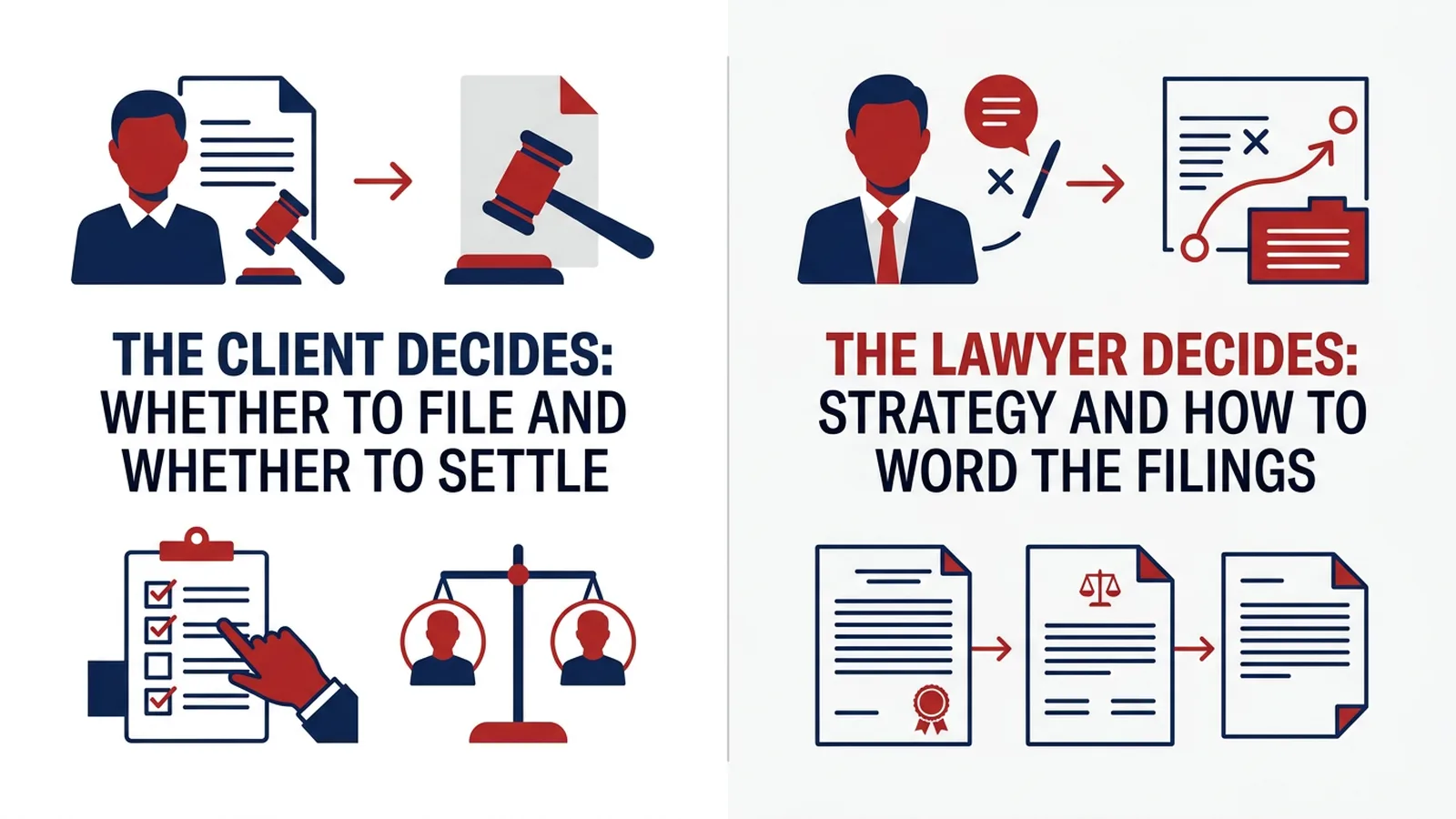
That picture is wrong, and I correct it at the start. Some decisions in a case belong to the client and some belong to me. Whether to file a lawsuit is the client's choice. Whether to settle, and for how much, is the client's choice too. The strategy, and how to file and word what goes to the court, is mine. This chapter draws that line, explains what mediation is and what a client can do inside one, sets out why I lean toward resolving a case without a trial, describes what happens when that does not work, and ends with how I measure success.
Behind all of it is how I understand the job. What people want from a lawyer, as I have come to see it, is someone to guide them with a calm hand. They assume I know the rules, because I went to law school. But they are not looking for a problem solver, a word I avoid because it takes away their ability to make decisions for themselves in their own case.
I have an expression that says a good settlement beats a great trial all the time.
Whether to file and whether to settle belong to the client
A lot of people are surprised by how much decision making a client has. Nobody forces a person to file a lawsuit. If I feel a case is one we can move forward on, I tell the client that, and then I say the decision is theirs. "You tell us yes or no."
The second decision is the one I treat as a hard and fast rule, and I tell clients about it right up front. Whether to settle a case, and for how much money, is totally up to the client. "I cannot and will not make that decision for you." I may come to a client with a number that I believe is fair. If the client does not think it is fair, the client can say no. That answer is theirs to give.
I say it early because of what I have seen people assume. They think that at the end of the case they will have no say over the outcome. Hearing at the beginning that they do gives them a lot of comfort.
A second reason is that going into a lawsuit is like going into a foreign country. You do not speak the language, you do not know where to go, and you need somebody to guide you, the way a tour guide does for a traveler. So I explain what the process looks like, how long it is going to take, what the potential outcomes are, what the decision points will be for you, and what your involvement is. People want a roadmap, and the settlement decision is one of the marked stops on it.
Strategy, briefs and wording belong to the lawyer
Many of the other decisions in a case are lawyer decisions. They are decisions about the strategy of the case: how to file something, how to write a brief, how to word it. Those calls are mine to make.
That does not mean I work in a closed room. I do bounce strategic ideas off my clients, and I make sure they hear from me on a regular basis about how the case is progressing. But the strategy is the purview of the lawyer, and I keep it there. The line comes down to whose case it is, and the work reflects that from the first interview. I let the client tell the story in their own words, from beginning to end, without interrupting, because they will tell me a lot of the information I am going to need. At the beginning of a case I also make sure my client's expectations and mine are aligned. The client's input matters to me because it is their case, not mine. I represent them, and the arrangement does not run the other way.
Mediation: a neutral person, an offer, and the right to say no
Many cases now go to some form of mediation, and I think virtually all of them do. Mediation is what we call alternative dispute resolution. The judges want the parties to get together with a mediator, who is neutral and has no stake in the case, and to see whether the parties can resolve it out of court.
Let's suppose we are at a mediation, and the other side comes up with a number to settle the case. I look at it and I think it is fair. You do not. You say to me, Frank, no thanks, I do not want it, I would rather end the mediation and go to trial. That is your right. The mediation ends, and the case moves toward trial.
I tell clients about this before a mediation begins. As I understand it, this is not a favor I hand out, and it is not even a matter of discretion among lawyers. It is in our rules. Even so, I make a point of explaining it, because "I think that is very empowering to people to know that they have a say in the outcome."
Control, finality, and the limits of a jury verdict
I lean hard toward negotiating and trying to resolve a case out of court, for two reasons.
The first is control. When you go to trial, the trial you expect to try is not the trial that happens. You are putting your case in front of jurors, the outcome is uncertain, and you do not know what a jury is going to do. You are leaving the decision in the hands of other people. When you negotiate a case, you keep much more control over where it ends up.
The second is finality. I believe every case deserves an attempt to resolve it, because "once the case is settled, it's over, it's final, it's done." A jury win does not carry that certainty. The other side can appeal, and an appeal can take years and years to move through the court system.
That is what I mean when I say a good settlement beats a great trial. Trials do happen. My point is that a settlement the client considers good puts the control and the ending in the client's hands, and a verdict, even a favorable one, hands both to a jury and then possibly to an appeals court. If the case cannot be resolved, or the client says no, we move on to trial.
What pushes a settlement offer up, and when negotiation ends
Several things shape an offer before the client ever has to say yes or no. One is insurance, which I take up in Chapter 13. The amount of insurance does dictate settlement. Let's suppose the damages in a case far exceed what a particular doctor's insurance covers. That doctor is probably going to think long and hard about going to trial and is going to want to resolve the case, because a judgment can be entered against an individual doctor, and nobody wants a judgment hanging over his head.
Another is the way the defendants behave toward each other. In the case I walk through in Chapter 17, the doctor was adamant about blaming the nurse, and we kept telling the other side in negotiation that we would present that finger-pointing to the jury. We were able to reach a settlement higher than we had anticipated. Finger-pointing can help a negotiation, but it is not a promise of a win or of a large settlement. I tell all my clients that we should manage our expectations. Sometimes, even though we advocate for large settlements, the doctors, the hospitals and the insurance companies are adamant and want to go forward.
Negotiation also has an end. We may have had settlement negotiations, and maybe even some friendly conversations, but once a case goes into litigation, "now all bets are off." Litigation is a battle, and all the parties are trying to do the best they can for their clients. If the case cannot be resolved, or the client says no, we move on to trial.
Success is the client's reaction, not my record
I measure success by the client's reaction. "Success is really defined by the client's reaction." Did they feel it was a success? I have won more cases than I have lost, and I have lost cases. "Any lawyer tells you they've never lost a case, I'd like to meet that person."
It would be easy to say that success is a large settlement or a large verdict. That is not how I see it. Going through a trial is an arduous journey, and I want the client to feel afterward that the experience was worth it. For that reason, I hold that success has to be "more client-centric than Frank Spector-centric."
I have seen what that looks like when a case did not go our way. Clients have said to me, "At least you fought for me."
Common Questions
- Can my lawyer settle my medical malpractice case without my approval?
- No, not in my practice. Whether to settle and for how much belongs to the client, and I tell clients so right up front. I put it this way: "If I come to you with a number, even if I think it's fair, if you don't think it's fair, you have a right to say, Frank, no, thank you." If you turn the offer down, we go forward toward trial.
- What is mediation in a medical malpractice case?
- Mediation is what we call alternative dispute resolution. The judges want the parties to meet with a mediator, "somebody who's neutral, that doesn't have any stake in the case," and see whether the case can be resolved out of court. Many cases go through it, and I think virtually all of them. If an offer comes up that you reject, you can end the mediation.
- Can I walk away from a mediation if I do not like the offer?
- Yes. If the other side comes up with a number I think is fair and you do not, you can tell me you want to end the mediation and go to trial. I explain that to clients before the mediation starts, and, as I understand it, it is in our rules. Walking away does not close the case. It moves the case toward trial.
- Why do lawyers push settlement instead of trial?
- For me it comes down to control and finality. A trial leaves the outcome with a jury, and you cannot know what it will do. A settlement ends the case. A jury win may not, because "Even if you win a jury trial, it's not over because the other side can appeal." An appeal can take years. The decision to settle still stays with you.
- Does the amount of insurance affect whether a case settles?
- Yes. "The amount of insurance does dictate settlement." If the damages in a case far exceed what a doctor's insurance covers, that doctor is probably going to think long and hard about going to trial, because nobody wants a judgment over his head. Chapter 13 covers insurance and why it shapes the whole case.
Chapter Reflection
Everything in this chapter turns on a single question: whose life does the outcome land on? It lands on the client, so the client holds the two decisions that matter most, whether to file and whether to accept an offer, and I hold the craft of getting the case there. A good settlement beats a great trial because it lets the client end the case on terms they chose. When the client says no, the case goes to trial, and that choice is theirs to make. A number, though, is only part of what a family brings to a lawsuit. The next chapter takes up the rest of what they are asking for.