
A lot of people assume that a call to a medical malpractice lawyer is a call about money. It is, in my experience, a call about something larger, and the money is only one piece of it. Families come to me after a surgery went wrong, a diagnosis was missed, or a delivery ended in a disaster. What they carry with them is hurt, confusion, and the sense that a relationship they trusted with their lives has gone quiet.
This chapter is about that part of the work, the part that does not fit in a damages calculation. It covers the two things a firm like mine tries to do, what families mean when they ask for accountability, the apology that clients sometimes ask about at the end of a case, and what it means to be a real person on the other end of the phone in a world of call centers and billing departments. It also covers what compensation can do for a family and what it cannot.
One limit comes before we start: nothing a lawyer does can turn back the hands of time. Chapters 11 through 14 cover the deadlines, the parties, the insurance, and the recovery a Maryland family can pursue. This chapter is about what sits underneath all of that.
They want some validation that the healthcare system let them down.
Holding the industry accountable and treating people with dignity
When I describe what Frank Spector Law is for, the answer comes in two parts. In my words, "We're trying to accomplish two things. We're trying to accomplish holding the medical industry accountable for their mistakes."
I do not say that lightly. A person's relationship with a doctor is one of the most trusted relationships in a life, because a patient is putting their life in that doctor's hands. Patients need their doctors to do things they cannot do for themselves, and not many people can do those things. That is why the next observation carries weight with me: "For some reason, accountability still seems to be a stumbling block in the medical industry."
The second thing is dignity. As I said at the start, there are two parts, and this one is about how a person is treated while they are in crisis. My core mission is to help people in a time of crisis, to treat them with dignity, and to do my best to make sure the process I take them through is explained.
A lawsuit is like going to a foreign country. You do not speak the language and you do not know where to go. Those of us who have gone on a trip hire a tour guide for exactly that reason. A person walking into a lawsuit may not speak the legal terms and may not have been through a process like it, so my job is to be the guide. I explain what the process looks like, how long it is going to take, what the potential outcomes are, what the decision points will be, and what the client's own involvement is. A lot of people just want a roadmap, and I think a roadmap gives them comfort.
Recognition from the system that failed them
Accountability is a big deal to a lot of the families I represent. Their lives have been turned upside down, and they are looking for something a check cannot give them. They are looking for the medical industry to recognize what happened. Unfortunately, in my view they do not get that in most cases.
I try to be careful about what families are and are not saying. They are not saying that mistakes do not happen. Families know that mistakes happen. What I hear is that knowing it does not mean they are willing to let it go.
So I tell my clients the truth about what I can offer. I cannot change what happened, and I wish that I could. What I can do is make sure we hold the system accountable. By the system I mean the medical industry and the way it answers for its mistakes.
That distinction matters because one of the biggest misconceptions I run into is that lawyers like me hate doctors. I say it plainly: I love doctors, I do not hate them, and several of them are my friends. The doctors in my life understand what I do. Chapter 6 takes up the myths about malpractice lawyers and the checks built into the system.
The apology families ask for and seldom receive
Let's say I am in a car accident and I hit somebody, and it was my fault. I know what I would do. "I would get up and I would get out of my car and I would say, I'm sorry, this is on me. I did this." We see a lot of accountability in our daily lives. All of us make mistakes, and when we do we say we are sorry.
Then I look at the medical profession, and the picture changes. "In the medical profession, they don't do that." I will not guess at the reasons. I can tell you what I have seen. I believe the only way to get accountability from the medical industry is to bring a lawsuit.
Even then, an apology is a different matter from accountability. Sometimes, at the end of a case, a client will ask me, "Do you think we can get an apology? Do you think we can just have them say I'm sorry?" I give the answer I believe is true. I tell the client I do not know, and I do not think so. In my thirty-five years of practice it has not happened much.
I cannot promise a family what the other side will say. What I can do is give a true answer when a family asks, and keep working toward the accountability a lawsuit can bring.
A real person on the phone, with compassion and integrity
The dignity I mentioned shows up in small ways first. The idea of customer service, of being treated with dignity wherever you go, seems to me to have been lost. A lot of people cannot get to see anybody anymore. Contact runs by phone and through call centers. People are dealing with insurance issues that seem to have no end, and they are billed for things they cannot make sense of. The frustration is real, and the whole experience feels impersonal.
So I want people to know this about me: "I'm a real life person. I'm not an AI robot and I'm here to help them."
When a new client calls Frank Spector Law, the rule is plain. A new client speaks to me directly, and Chapter 7 describes why. A caller who goes through an intake person may wait weeks or months for the question to reach a lawyer's desk, and then be told there is no case. I shortcut that process. The people who call have had their lives turned upside down by a medical mistake, and they still have family, work, and all the other responsibilities. Maybe they only have a lunch break to call. They want to know whether they have something or they do not, and I can answer that. As of this writing, I also use an AI phone assistant for calls that come in after hours, because many reception agencies no longer have live service around the clock, and I say so openly. I make sure that someone answers.
If you ask me for one sentence about what I stand for, it is this: "I stand for compassion and integrity."
In practice, compassion starts with listening. "I spend a lot of time listening. I don't talk over people, I let them tell their story." A lot of the people who call me have been hurt and ignored by the medical system. A patient has a good relationship with a doctor, something bad happens, and that doctor is gone from their life. They are angry and confused, and a lot of times they want to vent. Part of my mission is to give them the space to do it.
Compassion also means reassuring the mothers who call after a birth injury, many of whom feel guilty. They worry that a lawyer will blame them. I tell them they did not do anything wrong, that they went to the doctor and kept their appointments. I cannot change the way a person feels, but I want to give them some comfort in that conversation.
It covers the callers I cannot help as well. I talk with a lot of people whose situations do not make a case, and I tell them why. Many of them have called one lawyer after another without learning the reason. When I finally explain it, there is a sense of relief. Some of them tell me they wish they had a case, but that I am the only lawyer who took the time to listen and explain. That integrity is part of the job, and I find it satisfying, because I have the training and the information, and giving it to someone gives them clarity.
What keeps me going
A call from a former client, which I describe in Chapter 9, is part of what keeps me going. She had been a baby when I represented her, and hearing that she was all right meant a great deal to me.
That call is part of the answer when people ask what motivates me. The rest is what I see around me. There has not been much of a change, in my view, in how often medical mistakes happen. I see them getting more and more. "I wish they would go down, but they are not." People need help, and their lives have been changed forever. "And what motivates me is being able to just help a person."
I measure success the same way. It is not my definition that counts. "The success is dictated by the client." A thank-you at the end of a case means a lot to me. I have lost cases, and I have had clients in those cases tell me, "At least you fought for me." My hope is that the client feels the arduous journey of a lawsuit was worth it. It is not about me. It is about the client.
What compensation can do, and what it cannot
None of this means money is beside the point. Compensation is the power a medical malpractice lawyer has, and we talk a lot about it with families. I also know how it can sound, because talking about money with a family in this position can feel empty.
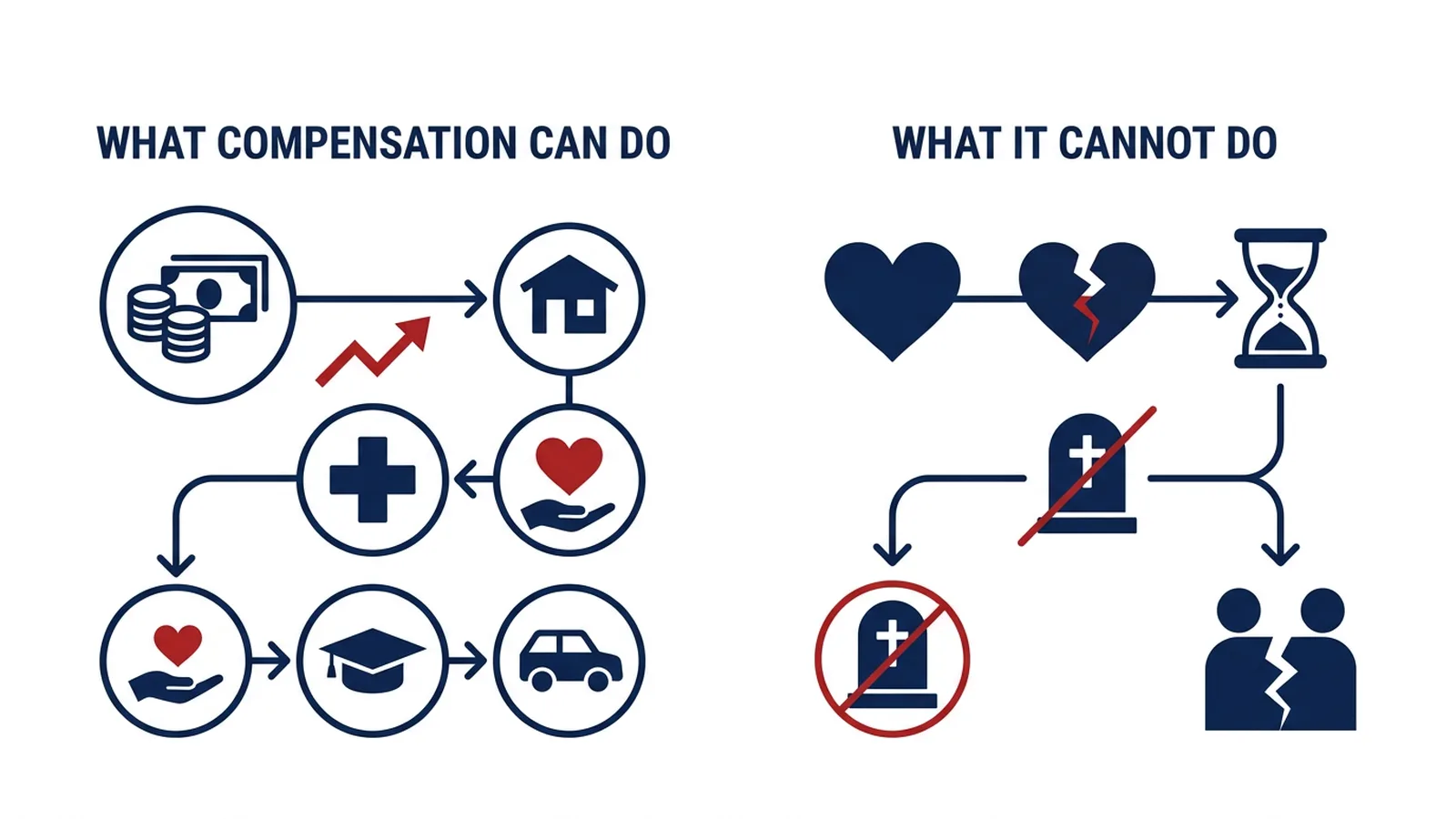
The honest framing starts with what I wish I could say: that I never wanted this family to be one of my cases, and that I cannot make it not have happened. Compensation does not undo an injury, and it cannot promise that anyone will say they are sorry.
What it can do is help people put their lives back together. Let's suppose you could no longer do what an ordinary morning asks of you, getting up, getting dressed, getting in your car, going shopping, going on vacation. Let's suppose you were in pain all the time, could not do your job anymore, and were fired. Let's suppose you needed therapies and other medical treatments that your insurance did not cover. Medical care costs keep going up, and, as I have seen it, so many people are being wiped out and forced into bankruptcy because of medical costs. Insurance, as I have seen it, does not cover 24-hour nursing care. Compensation can supplement what insurance and disability payments do not cover, and it gives a family the peace of mind to know the money is there to make life as good as it can be. Chapter 14 covers what a Maryland family can recover and what Maryland limits.
That is also why I reject the lottery picture. In thirty-five years, nobody who called me has phoned with great news. When I explain it this way, my clients understand that I am not judging them, and that I do not think they are there for all the money.
The bittersweet feeling comes back to me most in the cases where the result is good. In the delivery-room case I describe in Chapter 17, the settlement came out higher than we had anticipated, and I still call it bittersweet. "I wish the parents never had to call me." My job in a case like that is to make sure the child is adequately compensated for the rest of their life and gets all the care that child needs.
Common Questions
- Can a malpractice lawsuit make a doctor or hospital apologize?
- A lawsuit can bring accountability, but an apology is a different matter, and I cannot promise one. Clients sometimes ask me at the end of a case whether they can get one. My answer to them has been, "I don't know. I don't think so." In my thirty-five years of practice it has not happened much. I believe a lawsuit is the only way to get accountability from the medical industry.
- What do families mean when they ask for accountability after a medical mistake?
- They mean recognition from the system. Families understand that mistakes happen, and, in my view, "they understand that mistakes happen, but that doesn't mean that they are willing to just let it go." They are asking the system to acknowledge what it did. That is a large part of why accountability is a big deal to a lot of my clients, and why money alone does not settle it for them.
- Will a lawyer answer my call about a possible medical malpractice case?
- At Frank Spector Law, a new client speaks to me directly, and there are not many middle people on the line. "Many clients say to me, my gosh, I never thought I would speak to a lawyer." I do it because I want you to know you are important. As of this writing, for calls after hours I use an AI phone assistant, and I say so plainly, so that someone answers.
- Is a medical malpractice lawsuit about winning the lottery?
- No. That picture is bad press and propaganda, and nobody who has called me has phoned with great news. The families I work with expect to need money for things that insurance and disability payments do not cover, and compensation gives them peace of mind that it will be there. Nothing turns back the hands of time, but compensation can help with the cost of care.
- Why would a malpractice lawyer tell me I do not have a case?
- Most callers do not have a case, and I think they deserve the reason. Many of them have phoned lawyer after lawyer without getting clarity. When I finally explain it, there is a sense of relief, because at least they can close the door on that chapter and go on with their lives, even without a lawsuit. That clarity is a service in itself.
Chapter Reflection
A lot of families who call me are asking for more than a check. They want a person who listens, a system that answers for its mistakes, and an honest word about what a lawsuit can and cannot give back. Nothing turns back the hands of time, and in thirty-five years of practice an apology has not come often. What I can do is stay a real person through the process while the family decides what comes next. Chapter 20 turns to the distance between patients and doctors: the technology, the hospitalists, and the gap that opens when the person across the desk is no longer the doctor you knew.