
Building the Story of a Case: Themes, Bad Facts, and a Lawyer's Strategy
A lawsuit is a story that someone has to be able to tell. Before I can tell it to a jury, I have to know it myself: what happened, who was involved, and what it has cost a family. This chapter is about how I build that story. Most of what is in it I learned as a young lawyer, from the work and from the people who taught me.
When people ask what my strategy is, they tend to expect something clever. What I tell them is that it is mostly groundwork. It starts with a first interview where I listen, it moves to the medical records, and at each stage it checks that my client and I expect the same things from the case. Chapter 7 describes that first conversation and Chapter 8 describes the records. Here I want to show what ties those steps together, which is a story and a theme, and why a story only holds up when it is honest about its weak points.
Some of what follows is my opinion, and I will say so when it is. One idea in particular I picked up early in my career, and it carries a responsibility: a lawyer has to tell the client about it. It has a plain name, and it comes next.
One of the things that I learned as a young lawyer is something that we call a bad fact. Every case has a bad fact.
Groundwork before brilliance: how a strategy gets started
You might expect a malpractice lawyer to win by being clever. I learned something different. In my words, "it's not so much that you have to be the smartest lawyer in the world." A lot of what matters, as I see it, is the groundwork, and I build it one step at a time.
The first step is the interview. A client tells me the story in their own words, from beginning to end, and I try not to interrupt, because the information I am probably going to need comes out in that telling. The second step is the medical records, which I have called the Bible of a malpractice case and which a lawyer has to know intimately. The work behind those steps takes months of investigation before I can tell someone whether they have a case, though on a first call I can often tell a caller there is none. The way I say it, "it's all in the preparation beforehand."
Running through all of it is a check on expectations. A strategy, as I see it, means having a good idea of what the case is about and a good idea of what the client expects, and the two have to line up at the beginning and again at each step of the investigation. I don't count that as an extra. It is part of rolling up my sleeves and doing the hard work.
A story and a theme, from the first conversation
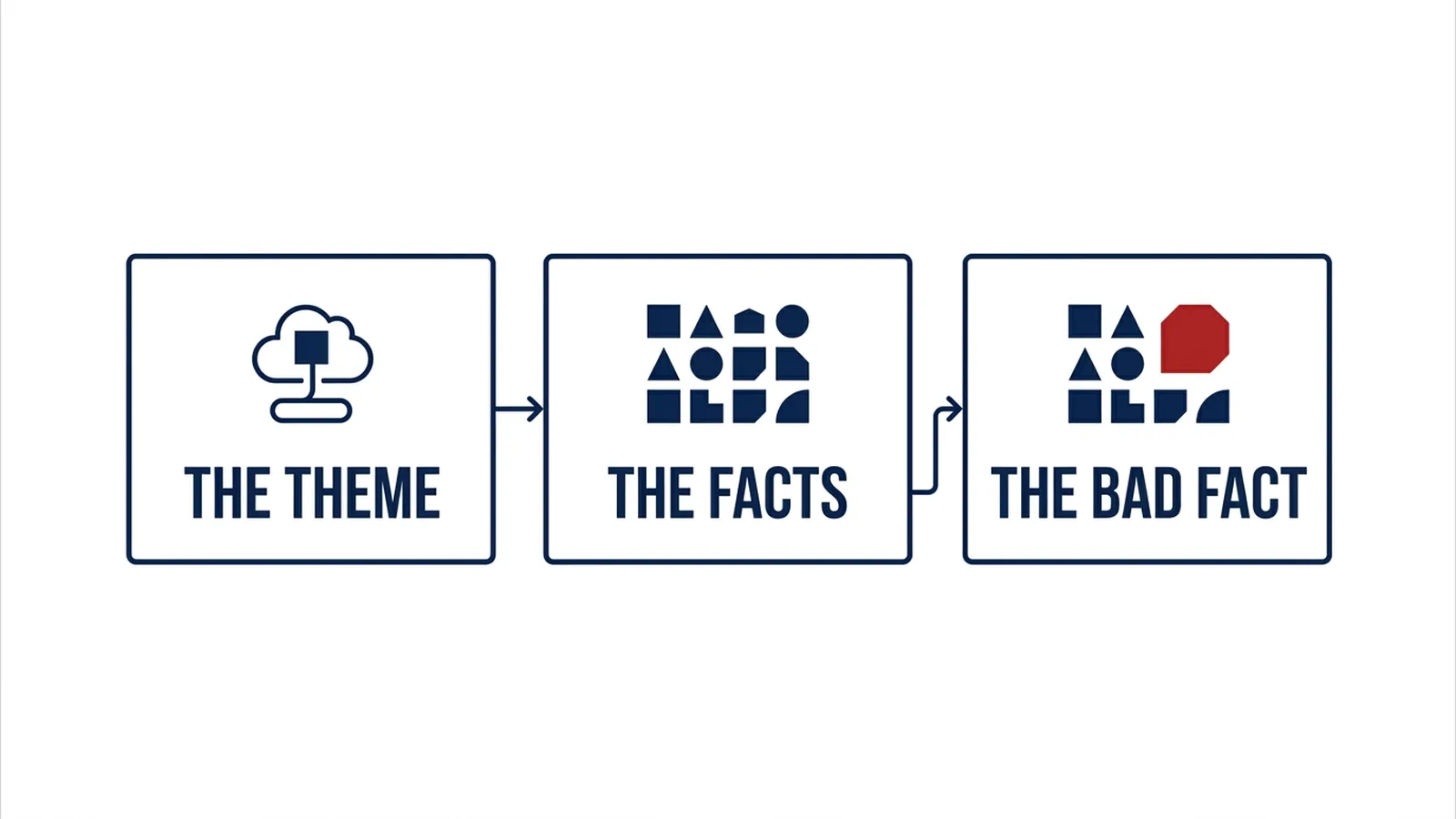
While I am interviewing a client, I am already thinking about what the case will look like when it is told. In my words, "what I'm trying to develop is a story, a theme. Because people connect with stories and they connect with themes. All of us do."
Think about what happens when someone starts a sentence with "Let me tell you a story." "Our ears perk up and we become interested." That is true of all of us, and I take it seriously when I build a case.
Step one is listening. I can't develop a story without hearing one, so the interview comes first and the theme follows from it. After that the job is to use the records and any other information I collect to "fill in the gaps of that story or to fill in the pieces of that story." The facts do not stay a pile. They are what the story is made of.
What a bad fact is, and why it comes back at trial
What we call a bad fact is something someone did that you wish they hadn't. The way I put it, "there's something that somebody did that you wish they didn't. And it's on both sides." The lawyer who represents the doctor has bad facts too, things that lawyer wishes the doctor had not said or done.
The lesson I took from that is that you cannot ignore one. In my words, "you can't ignore a bad fact. A bad fact is gonna come back, it's gonna be there throughout the whole case." It does not go away because nobody brings it up. It stays in the case from beginning to end, and at trial it is something we will hear at the start.
The other side gets to make its case too, and Maryland gives it a defense that I will only touch on here, called contributory negligence. Maryland is one of a small handful of states that has it. As I explain the rule, if a jury finds that a patient contributed to the negligence even a little bit, the patient can lose the entire case. Let's suppose a doctor's lawyer says the patient did not show up to appointments or did not take the medicines the patient was told to take. That is raised as a defense, not as a claim against the patient, and Chapter 16 takes up the difference. I have said that in a malpractice case the defense is probably not going to press it, because it does not want the jury to think it is blaming the patient for something that was its own responsibility.
Telling a client the hard part, including the gray areas
This is where the term stops being vocabulary and becomes a duty. If I feel a bad fact is so serious that I don't think it would be a responsible decision to continue with the case, I believe I have a responsibility to tell that to my client. Even though I think I'm smart, "I'm not gonna be able to lawyer it away." Telling them is a strategy "that only a lawyer can do because we really only know the significance of that."
Telling is not deciding. Whether to file a lawsuit is the client's choice, and no one forces it. When I think a case is one we can move forward on, I say so, and I add that the decision is theirs. Chapter 18 returns to who decides.
The same honesty applies to the gray areas. Chapter 2 explains what a judgment call is and where the law draws the line around it. What I add here is how it sounds to a client. Many times I have to say to my clients that a question in their case is a gray area, a judgment call, and that plain answer is part of telling them the truth about the case.
Each witness and each step should move the story along
Once a case has a story and a theme, the strategy is mostly a matter of staying inside them. The way I put it, "the overall strategy is to make sure that we are staying within the story and the theme that I talked about." That applies to the people who testify and to the smaller work in between. In my words, each witness matters for the same reason: "every time we're doing something in a case, we're trying to advance that story."
A lot of that work belongs to the lawyer. Many of the decisions about the strategy of a case, such as how to file something, how to write a brief and how to word it, are a lawyer's decisions. I bounce strategic ideas off my clients, and I make sure they hear from me on a regular basis about how the case is going, but "it really is the purview of the lawyer."
I will leave the rest as a belief and not a promise. If you stay within the story, I think you are going to be more successful than not.
A mentor, a frightening start and what I pass on
I did not come to any of this alone. As I said in Chapter 2, I have had great mentors along the way, and I think young lawyers who have mentors may not be as common as they used to be. After law school I had probably one of the best trial lawyers in Baltimore as my mentor. He showed me how to be a trial lawyer, including "how to take control of a courtroom, how to present yourself to a jury," and a good deal that was just intangibles.
That gave me a basis to launch my own law firm. I had an entrepreneurial spirit, and I wanted to do things the way I wanted to do them and provide the services I wanted to provide. "It's scary when you're a young person starting out your own law firm." You do not know whether you will be successful, and there are a lot of lawyers out there. I had confidence in myself, and my wife had confidence in me. She was a big supporter then and she has been ever since.
What I figured was simple: "if I just do the right thing and I do the right work and I hold myself with integrity, that things would work out." Slowly but surely, they did.
Part of what I try to do now is pass that on. When I taught at my law school as an adjunct professor, I talked with students about what practice is like in the real world, how to manage yourself in a firm, how to decide on a practice area, how to meet people. "I was able to get that from a mentor and I was able to pass that along to students."
Common Questions
- What is a bad fact in a lawsuit?
- A bad fact is something someone did that you wish they hadn't, and it exists on both sides of a case. A lawyer cannot ignore one, because as I put it, "It's gonna come back to haunt you at the end." In my view the lawyer's job is to know it is there and to deal with it directly, starting with the client.
- Should a lawyer tell a client about a weak point in the case?
- Yes, if it is serious. When a bad fact is so serious that continuing would not be a responsible decision, "I believe you have a responsibility to tell that to your client." A weak point does not disappear because nobody mentions it, and a lawyer cannot talk it away. What the client does with that information is the client's choice, because the decision to file belongs to them.
- What does a lawyer mean by the theme of a case?
- It is the story the lawyer builds the case around. I start developing it at the first interview, and I say it plainly: "I'm thinking of a theme from the first time I'm talking to the client." Step one is still listening. After that I use the information I gather, from the client and from the records, to fill in that story.
- Why do trial lawyers think of themselves as storytellers?
- Because, as I see it, the work is storytelling and persuasion. I put it this way: "I think trial lawyers are a special breed because we're storytellers." People connect with stories and themes, which is why I try to find the story and the theme of a case at the start and keep each witness and each step inside it.
Chapter Reflection
The whole chapter serves one story. The groundwork gives it facts, the theme gives it a shape, and each witness and each step is there to move it forward. The bad fact is the part that tests the lawyer, because it stays with the case, and the lawyer's part is to tell the client what it is. Chapter 16 follows the story into the stretch of a lawsuit where defendants who may have stood together begin pointing at one another. A bad fact that nobody mentions is still in the case.